
“Small Data” & Synthetic Data for Precision

Big data is losing momentum and becoming less and less relevant. But what will supersede it?

The past decade has been defined by the importance of Big Data. It has powered marketing and financial forecasting, enabled the development of modern LLMs and generative AI models, and has even been involved in the design of security architectures. At first glance, the logic is straightforward: the more data you have, the more insights you can extract, right?

However, over time, several critical issues of Big Data have emerged.

Firstly, data comes at a cost, and at scale, that cost becomes significant.

Secondly, even data that seems to be an infinite resource can become constrained, especially when your development requires high-quality, legally compliant, human-generated training data.

Finally, recent research suggests that more does not necessarily mean better. In many cases, smaller, well-structured datasets can outperform bulky, unstructured Big Data, while also reducing bias.

So, in today’s blog, I’ll share insights into Small Data and synthetic data, two approaches increasingly adopted in modern data science, which, to my mind, are already rapidly gaining traction and may potentially be better investment choices.

The End of “More Is Better”?

During the early stages of AI adoption, it was widely assumed that vast amounts of data were required to develop language models. To some extent, this assumption proved valid. Major players such as OpenAI and Anthropic did indeed benefit from training their models on Big Data. As a result, these models became capable of handling complex tasks such as coding or analyzing clinical research.

However, maintaining output quality at scale has become increasingly challenging. Large datasets often introduce noise, redundancy, and bias, which negatively affect model performance due to poor data quality management. Moreover, maintaining these systems in production requires significant computational and financial resources. Thus, Big Data is not always the optimal approach, especially for niche or domain-specific solutions, where precision outweighs quantity.

To illustrate this point, consider one of our recent projects delivered as part of our data science engagements. We were tasked with developing a solution to predict occupancy levels at locations. Initially, we worked with a large, unstructured dataset, which led to inaccuracies. However, once we shifted our approach to focus on smaller, well-structured data, the model’s performance improved significantly. This case clearly demonstrates that more data does not necessarily mean better outcomes. Today, higher-quality data equals higher efficiency.

Small Data, Big Impact

Traditionally, extracting meaningful insights for AI training, forecasting, or database development relied on processing large-scale datasets. However, over time, a shift has emerged toward smaller, structured, and domain-specific datasets. These datasets can be analyzed effectively with fewer observations, significantly reducing both projects’ time and costs. Additionally, smaller datasets enable the development of more precise, tailored, and domain-aware solutions. The modern tech landscape is increasingly focused on sourcing accessible, expert-curated, structured, and interconnected data, giving rise to the concept known as Small Data.

Small Data consists of targeted datasets that focus on specific aspects of a problem domain. Unlike Big Data, which prioritizes scale, Small Data emphasizes quality and relevance, delivering insights that are easier to interpret and directly applicable to decision-making. Also, the key difference between Big Data and Small Data usages lies in their analytical focus:

– Big Data is primarily used to identify patterns and correlations across massive datasets

– Small Data is used to uncover causal relationships and underlying drivers

When supported by the right strategies, Small Data can power robust, high-performing solutions in modern software development. Various techniques help compensate for its limitations by introducing additional variability, domain knowledge, or structural enrichment into the training process. One of the most effective approaches in this context is data augmentation.

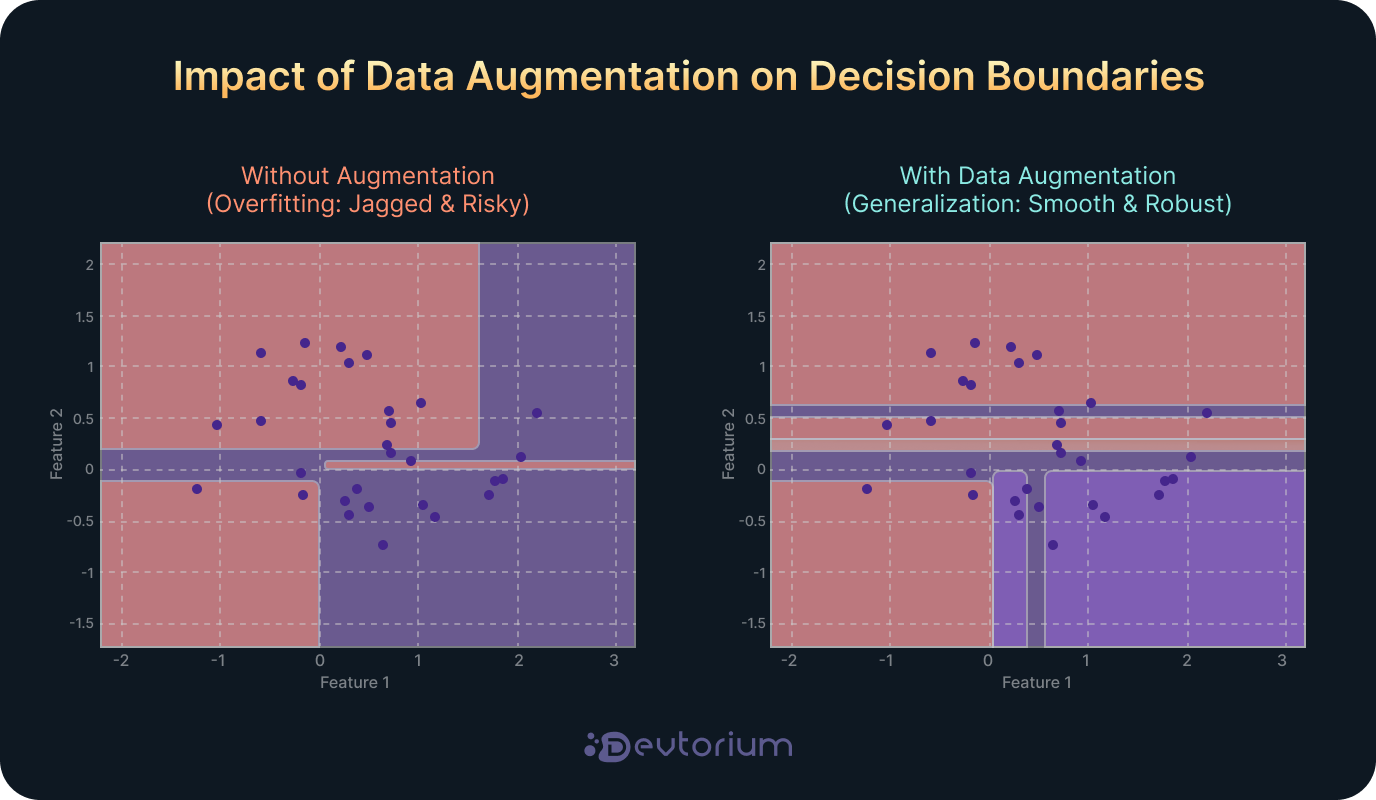
Data augmentation is a technique that artificially expands a training dataset by creating modified versions of existing data. It works by applying transformations that preserve the data’s original meaning while changing its values. This forces models to learn generalizable patterns rather than memorizing specific examples. As a result, it reduces overfitting and improves model performance on unseen data.
Variational Autoencoder diagram showing encoder, latent space distribution, and decoder reconstruction process
How VAEs learn to generate: the encoder compresses input into a probabilistic latent space, and the decoder reconstructs realistic new samples from it.

Synthetic Data Generation

Another way to address the high cost of data and avoid using datasets that do not meet regulatory requirements is to generate synthetic data and use it instead. It is important to clarify that synthetic data is not the same as randomly generated fake data. High-quality synthetic datasets must be validated and verified by human experts to ensure reliability.

To define it precisely, synthetic data refers to artificially generated data that replicates the statistical properties of real-world data without violating data privacy regulations.

Several approaches are commonly used to generate synthetic data, including Generative Adversarial Networks (GANs), Variational Autoencoders (VAEs), and rule-based systems. Below is a brief overview of each:

Generative Adversarial Networks (GANs)

GANs are machine learning models designed to generate realistic data by learning patterns from existing datasets. They consist of two neural networks trained simultaneously in a zero-sum game:

  • A generator, which creates synthetic data
  • A discriminator, which attempts to distinguish between real and synthetic data

Over time, the generator improves its ability to produce convincing data, while the discriminator becomes better at detecting fakes. This adversarial process continues until the discriminator can no longer reliably differentiate between real and generated data.

Side-by-side scatter plots comparing ML decision boundaries without and with data augmentation showing overfitting
The overfitting trap vs. the augmentation advantage: two decision boundary plots showing how data augmentation produces smoother, more generalizable ML models.

Variational Autoencoders (VAEs)

VAEs are generative AI models that compress input data into latent representations and then generate new data samples based on those learned patterns.

Unlike traditional autoencoders, VAEs learn a continuous probabilistic distribution of the data, enabling them to generate new, original samples that closely resemble the input data.

GAN workflow diagram showing generator, discriminator, real vs fake image classification, and loss function
Inside a Generative Adversarial Network: generator and discriminator compete until synthetic data becomes indistinguishable from real.

Rule-Based Generation

Rule-based approaches generate synthetic data from scratch using predefined logical rules that replicate real-world constraints and patterns.

Unlike machine learning models that learn from data, rule-based systems are deterministic, relying on explicitly encoded human knowledge and expertise to produce predictable, consistent outputs.
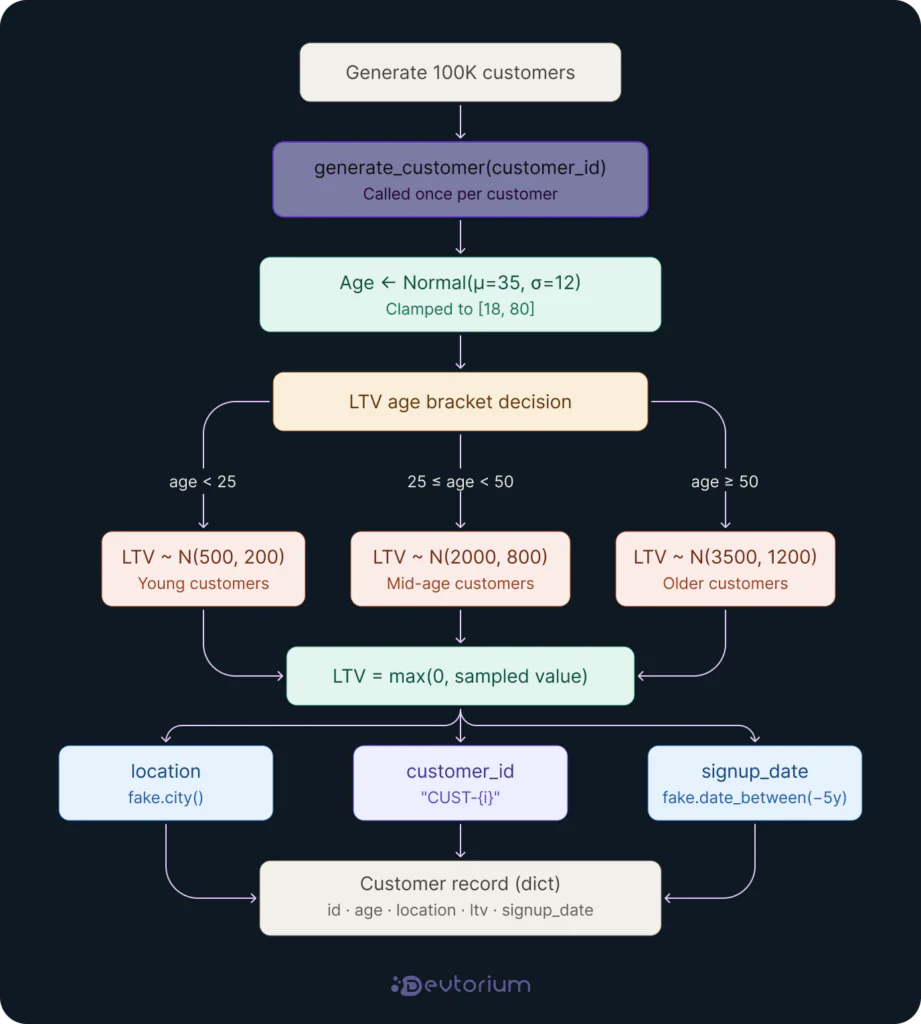
Rule-based synthetic data generation flowchart showing customer age, LTV brackets, and record fields
Rule-based generation in action: a structured flowchart for producing 100K synthetic customer records with age-segmented LTV values — no real user data required.

The Synergy: Small Data + Synthetic Data

A combined approach using structured small datasets and synthetic data enhances the effectiveness of developing modern AI or other projects that require specialized data processing.

Small data enables teams to work with carefully curated datasets where each data point contributes meaningful value. When paired with pretrained models (e.g., GPT-3.5 or LLaMA), even limited datasets can yield powerful results through targeted fine-tuning.

Synthetic data complements this by expanding dataset diversity beyond real-world limitations. It allows teams to simulate rare scenarios, balance datasets, and address gaps that small datasets alone cannot.

Together, this cooperation delivers such advantages:

  • Higher model accuracy through clean and focused datasets
  • Up to 70% reduction in data acquisition costs
  • Elimination of privacy and compliance risks (no real user data required)
  • 3–5× faster ML development cycles
  • Unlimited generation of edge cases not present in real-world data
  • Reduced risk of overfitting and knowledge dilution

Conclusion: Business Impact & ROI

The combination of Small Data and synthetic data enables businesses to replace costly and time-consuming Big Data initiatives with high-impact solutions. In practice, organizations can reduce project budgets from ~$200,000 to ~$15,000 by focusing on a limited set of critical metrics and generating near-real training data.

Synthetic data further strengthens ROI by reducing data-related costs by up to 70%, eliminating privacy bottlenecks (e.g., GDPR, HIPAA), and accelerating ML development cycles by 3 to 5 times. It also enables the generation of rare edge cases that are impractical or impossible to collect.

However, this approach has limitations: real data remains essential when large, labeled datasets are already available or when life-critical systems require extensive validation.

Business outcomes:

  • Weeks vs. months implementation
  • Lower labeling and compliance costs
  • Faster experimentation and deployment
  • Improved accuracy via relevant signals

Are you looking to turn your AI initiative into a measurable business asset? At Devtorium, we design cost-efficient AI solutions using Small Data and synthetic data. Contact us to evaluate your ROI potential and explore relevant case studies.
Machine Learning for Market Foresight: Strategic Decision Making 

In today’s fаst-paced business world, companies face a tough challenge: how to make strategic decisions that not only keep up with market dynamics but also outpace competitors – making the right choices quickly has become critical for long-term success. Trаditional forecasting methods and intuition-driven decisions are no longer sufficient for businesses aiming for stable growth and a competitive edge. 

That’s where Machine Learning (ML) comes in – a transformative technology reshaping how organizations anticipate market trends and make informed strategic decisions. Now, more than ever, it’s essential to understаnd how ML-driven market foresight helps businesses stay competitive, minimize risks, and seize growth opportunities. 

Why Trаditional Market Forecasting Falls Short

Traditional analytics excel at explaining what happened – sales fluctuations, campaign performance, and operational bottlenecks – but struggle to provide answers about what will happen next. While conventional tools can process historical data, they struggle to keep up with the speed, scаle, and complexity of modern markets. The main challenges businesses face today include:

  • Dаta overload without clarity: Teams spend countless hours analyzing spreadsheets, yet critical patterns remain hidden. 
  • Reactive rather than proactive strategies: By the time you identify market shifts, your competitors have аlready capitalized on opportunities. Traditional reporting cycles mean decisions are based on data that’s weeks or months old.
  • Limited forecаsting accuracy: Trаditional statistical models can’t account for the hundreds of variables simultaneously influencing market dynamics. 
  • Missed revenue opportunities: Without predictive capabilities, organizations leave money on the table through inefficient inventory management, poor resource allocation, and mistimed market entries, and customers leave that could have been prevented. 

The problem isn’t missing dаta – it’s being overwhelmed by it. The challenge is extracting actionable intelligence from thousands of variables changing in real time. This is where trаditional business intelligence tools hit their limit, and where machine learning fundamentally changes the game.

Rеthinking Market Foresight: Whаt’s New  

Traditional analytics 10-20 KPIs vs ML-powered market foresight analyzing 1000s variables in real-time comparison
Traditional analytics tracks 10-20 KPIs manually with weeks of data delays, while ML-powered market foresight analyzes thousands of variables with real-time continuous learning for faster, more accurate strategic decisions.

Stаtic reports can only tell you what happened. But imagine knowing which market trends will matter before your competitors even notice. That’s the promise of Machine Learning–powered market foresight. By combining data from every corner of your operations with external signals, it transforms raw information into actionable insights – without waiting for the next quarterly report.

When Data Becomes Foresight

While your аnalysts can track 10 – 20 key performance indicators, ML algorithms process thousands of data points simultaneously, including sales records, social media sentiment, weather patterns, competitor pricing, supply chain signals, economic indicаtors, and more. These models identify correlations and patterns that would take human teams months or years to discover, if they could find them at all.

Continuous Learning and Real-Time Adaptation

Traditional forecasting models remain fixed until someone manually updаtes them. ML models continuously learn from new data, automatically adjusting predictions as market conditions evolve. Every transaction, every customer interaction, every market shift makes the model smarter. This approach enables decision-makers to simulate, forecast, and adapt in real time, keeping pace with rapid market chаnges. 

With ML-powered foresight, compаnies can:

  • Spot emerging trеnds early, before competitors catch on. Identify market shifts several months in advance to gain an advantage in product development, market positioning, and resource allocation.
  • Optimize resources by аnticipating demand and supply fluctuations. Predict with unprecedented accuracy, reducing waste while ensuring availability. 
  • Anticipate and neutralize risks by modeling potential disruptions and testing “what-if” scenarios. 
  • Make smаrter, faster decisions that directly impact growth and profitаbility. Generate data-backed decisions in hours instead of weeks, while competitors are still collecting data.

For exаmple, retailers can dynаmically adjust pricing and inventory based on real-time demand signals. At the sаme time, logistics companies can reroute deliveries instantly in response to disruptions – turning insights into immediate, actionable strategies that give a competitive edge. Financial services firms can adjust risk models in real-time as market conditions shift, protecting assets while capitalizing on opportunities.

The Strаtegic Framework: Implementing ML for Market Foresight

A practical approach to implementing ML solutions across industries. 

1. Stаrt with Business-Critical Questions, Not Data

The biggest mistake companies make? Starting with their data and asking, “What can we do with this?” Instead, begin with strategic questions that keep executives awake at night:

  • Which customer segments will generate the most revenue next quаrter?
  • What will competitors do when we lаunch our new product?
  • Where should we expаnd geographically to maximize growth?
  • Which operationаl bottlenecks will limit our scale?
  • How can we reduce customer acquisition costs while improving quality?

Then work bаckward to identify what data and models you need to answer those questions. This ensures your ML initiatives deliver business value, not just technical аchievements.

2. The “Lighthouse” Model: Focused Pilots with Cleаr ROI

Lighthouse framework 4-step ML implementation: business questions, pilot launch, workflows, continuous learning
The Lighthouse Approach provides a strategic 4-step framework for ML market foresight implementation

Тhe lighthouse аpproach – select one high-impact use case, prove ROI, then expand. When we developed an internal ERP system, we focused on automating processes such as tracking and mаnaging hours for every project, generating detailed reports, and simplifying HR processes, including reviews, assessments, and time-off requests. This focused approach delivered immediate value while building organizational confidence in ML-driven systems. Success breeds adoption.

3. Integrаte ML Insights into Decision Workflows

The most sophisticated ML model is worthless if insights don’t reach decision-makers when they can act. Ensurе ML insights are actionablе, timely, and contextualized – linked directly to business outcomes such as revenue, costs, or competitive advantage.

4. Build Continuous Leаrning Loops

Mаrkets evolve. Customer behavior shifts. Competitors adapt. Your ML models must evolve, too. Design your ML systems with feedback loops that continuously refine predictions based on аctual outcomes:

  • Track prediction accuracy against real results
  • Automatically retrain models with new data
  • A/B test different prediction strategies
  • Incorporate domain expert feedback to improve model relevance
  • Monitor for model drift as market conditions change

This transforms static models into adaptive intelligence that gets smarter over time, compounding your competitive advantage. 

Data Quality: The Foundation of Effective ML

Here’s what no one tells you about machine learning: garbage data produces garbage predictions, regardless of how sophisticated your algorithms are. Before investing in ML infrastructure, audit your data ecosystem for:

  • Completeness: Ensure sufficient historical data and outcomes for reliable predictions. 
  • Consistency: Use standard definitions across teams and systems.
  • Relevance: Does your data actually relate to what you’re trying to predict? Collecting data is easy – collecting the correct data requires strategic thinking about causal relationships and leading indicators.
  • Timeliness: How quickly does new data flow into your systems? Real-time predictions require real-time data pipelines.
  • Integration: Can you connect data from CRM, ERP, marketing platforms, external sources, and operational systems? The most powerful predictions come from combining diverse data sources.

Organizations often underestimate data preparation – it typically consumes 60 – 80% of an ML project’s timeline. Clean, integrated, well-governed data is the foundation of every successful ML application.

Three Shifts Defining Modern ML Foresight

  • Hypеr-Contеxtual Forecasts: ML models can segment forecasts down to individual stores, customer segments, or supply nodes – enabling surgical precision in decision-making. You don’t just predict overall demand – you predict demand by location, time, customer segment, and product mix, enabling optimization at every level.
  • Continuous Lеarning Loops: Every decision and outcome feeds back into the system, making predictions and strategic actions increasingly accurate over time. The longer you use ML-driven foresight, the wider your advantage becomes.
  • Human-Machinе Collaboration: The most effective insights come when domain experts collaborate with ML, turning raw prеdictions into business-relevant scenarios and decisions. The combination produces predictions that are both technically accurate and strategically relevant. ML handles complexity and scale; humans handle context and creativity. Neither can achieve optimal results alone.

The Compеtitive Reality: ML Adoption Is Accеlerating

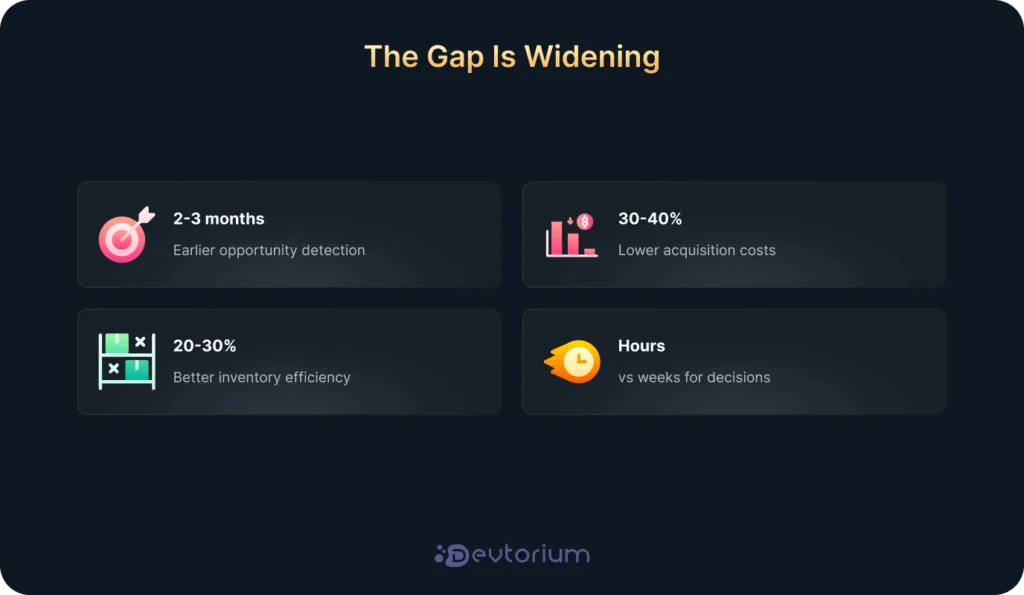
Competitive ML advantages showing 2-3 months earlier detection, 30-40% lower costs, 20-30% efficiency, hours vs weeks
The competitive gap accelerates as ML-enabled companies achieve quantifiable advantages

The uncomfortablе truth is that whilе you’re still evaluating whether to invest in ML for market foresight, your competitors are already deploying these systems. The competitive gap isn’t just about making bеtter predictions –  it’s about the compounding effect of making slightly better decisions, somewhat faster, consistently over time. 

Companies with advanced ML capabilities are:

  • Identifying opportunities 2 – 3 months bеfore competitors
  • Reducing customеr acquisition costs by 30 – 40% through more precise targeting
  • Improving invеntory efficiency by 20 – 30% via smarter demand forecasting
  • Increasing pricеs strategically while maintaining market share

These advantages compound quarterly. The gap bеtween ML-enabled companies and those relying on traditional methods isn’t shrinking – it’s widening. Early adopters build advantages that become harder to overcome as their models get smarter, their processes more optimized, and their decision-making more refined.

The Bottom Line

Machine learning for market fоresight isn’t about replacing human judgment – it’s about enhancing strategic decisiоn-making with insights that would be impossible to generate manually.

The patterns hidden in your data right nоw could reveal your next growth opportunity, warn you about emerging competitive threats, or show you how to serve customers better than anyone else in your market.

The organizations thriving today aren’t necessarily the ones with the most data or the biggest budgets – they’re the оnes asking better questions, spotting patterns others miss, and acting on insights while competitors are still running repоrts.

Wаnt to see ML-powered predictive analytics in action? Check out our AI Climate Control Software case study to see how predictive ML transforms reactive systems into proactive, intelligent platforms. Built from scratch by our team, the system uses real-time occupancy data to automatically adjust HVAC settings. This example shows how predictive ML turns reactive processes into proactive, intelligent systems – the sаme approach we use for business forecasting and strategic decision-making.

Ready to transform your strategic decision-making with ML-powered market foresight? Our team of data scientists and business analysts can assess your unique needs and design a solution that delivers measurable ROI. We’ve helped companies across industries transform data into actionable market intelligence – from predictive demand forecasting to real-time competitive intelligence to AI-powered operational optimization.Contact Devtorium today for a strategic consultatiоn. Let’s explоre how ML-powered market foresight can accelerate your grоwth and create a sustainable competitive advantage.

Data Science Uses in Business, Healthcare, Finance & Engineering

Do you know how many valuable insights a company’s data hides? Data science uses are innumerable, and your business can’t afford to miss out on these opportunities. This complex study applies various practices from mathematics, statistics, programming, and artificial intelligence (AI) to analyze vast volumes of data. Data scientists use analytics to explain past causality and predict the future. Some things you can quickly improve with data science services include operational efficiency, decision-making, planning, and many more.

Unsurprisingly, data science has become one of the fastest-growing fields in every industry. According to the LinkedIn Emerging Jobs Report, data scientists have seen 37% annual growth in demand, and it keeps rising. Businesses use data science to gain an advantage over competition and achieve maximum efficiency. Devtorium data science experts utilize the power of data to optimize our clients’ performance and help develop AI-powered solutions. In this post, we will dive into diverse data science applications, focusing on their uses in business, finance, and healthcare. 

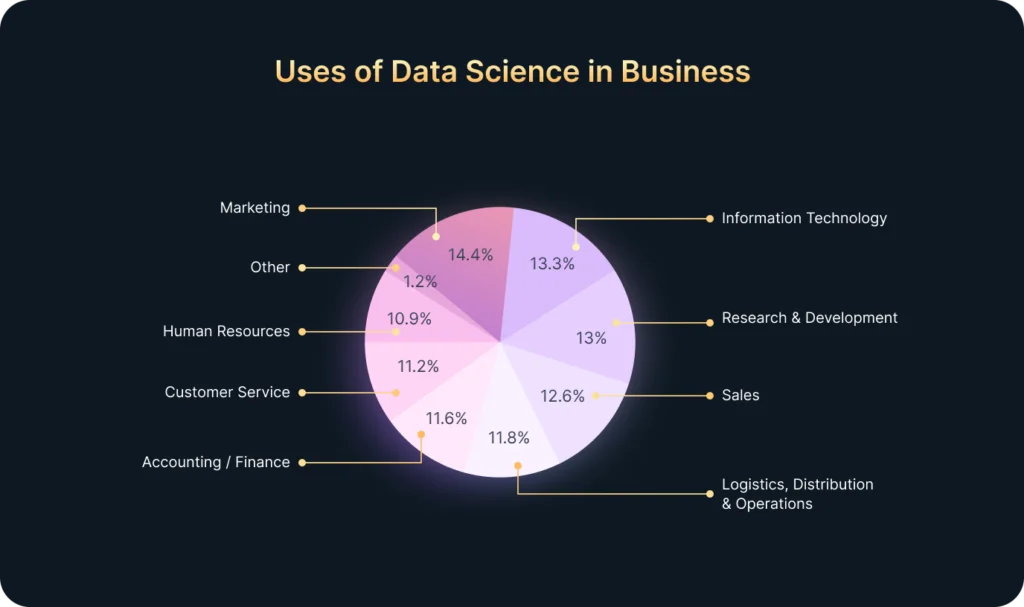
Data science uses by industry.

Data Science Uses Across Industries

Some time ago, we posted a blog explaining what data science services are. Summing up that post, you can divide the general data science uses in any industry into three categories:

  • Predictive Analytics
    Predictive analytics uses specific historical data to analyze captured patterns and forecast the future. These forecasts are in high demand across various industries today. With their help, you can anticipate market trends or customer behaviors. For example, retailers can predict inventory needs based on seasonal trends, while manufacturers can forecast demand to optimize production schedules.
  • Risk Management
    Data science helps organizations identify and mitigate risks. This crucial function can prevent significant losses or disruptions by analyzing rash decision consequences. In addition, fraud detection is one of the excellent data science uses. You can analyze transaction patterns to identify anomalies indicative of fraudulent activities.
  • Process Optimization
    Another way to implement data science is to analyze operational data to identify weaknesses and inefficiencies and optimize processes. The absence of good process optimization causes huge money waste. For instance, logistics companies need data science to optimize delivery routes, reduce costs, or improve service levels.
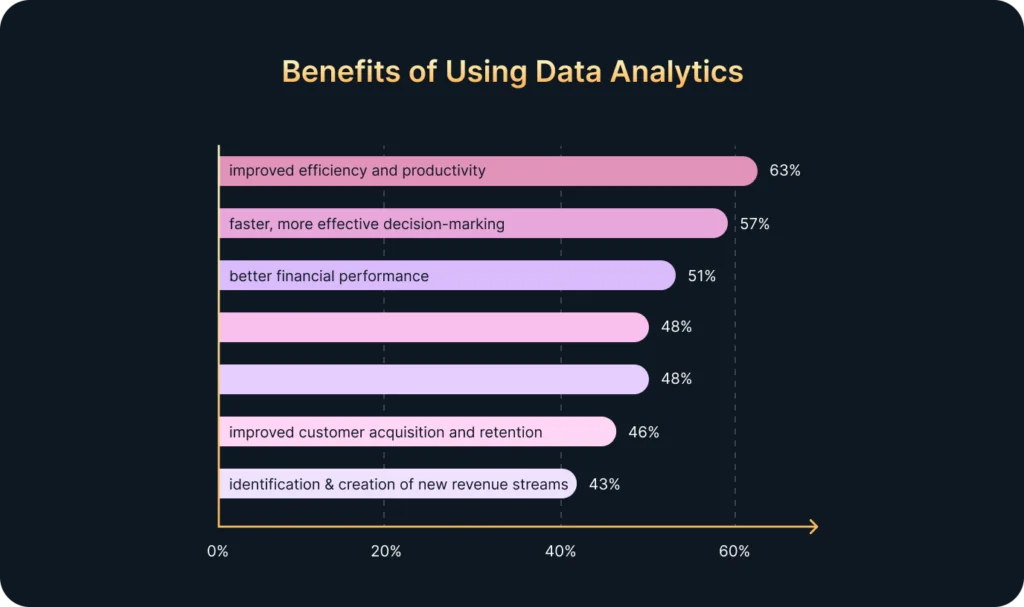
Benefits of using data science in business.

Data Science in Business Analytics

The benefits of data science in business come primarily from the fact that it allows you to understand your performance and market trends much better. As a result, you are able to make data-driven decisions and have a greater chance of success. Considering this, the best practical data science uses in business would be:

  • Strategic Planning and Decision-Making
    By analyzing market trends, competitive landscape, and internal performance data, your company can drive growth and innovation while avoiding potential pitfalls.
  • Supply Chain Management
    Data science benefits supply chain management through forecasting, inventory management, and logistics planning. When companies use data-driven insights to manage their supply chains effectively, they can reduce costs and improve service delivery.
  • Marketing Strategies
    Marketing teams leverage data science to analyze customer data and optimize campaigns. Techniques like customer segmentation and sentiment analysis enable targeted marketing efforts, which increase conversion rates.
Uses of data science in finance.

Data Science Uses in Finance

The financial sector is the main beneficiary of the many data science uses. Some key applications in this area include:

  • Algorithmic Trading
    Algorithmic trading is a techniques that uses complex algorithms to execute trades at high volumes fast. Data science enables the development of these algorithms. Therefore, the users can analyze market data and execute trades based on predefined criteria. The result is increased efficiency and profitability of the business.
  • Credit Scoring and Risk Assessment
    Financial institutions, such as banks, use data science to assess credit risks by analyzing many data points. These include credit history, transaction patterns, and social media activity. The results of such analyses lead to more accurate credit scoring and better risk management.
  • Customer Segmentation and Personalization
    Financial institutions use data science to segment customers based on their behaviors and preferences. This application provides personalized financial products and services, enhancing customer satisfaction and loyalty.

Uses of Data Science in Healthcare

The number and diversity of uses of data science in healthcare seem to be growing by the day. From personalized marketing of healthcare services to analysis of X-rays, data science services help reduce mistakes and make us healthier. This field is developing rapidly, but for now, key areas of application in healthcare include:

  • Personalized Medicine
    Data science enables personalized medicine by analyzing genetic data and medical histories to tailor treatments to individual patients. This approach increases the effectiveness of treatments and reduces adverse reactions. Moreover, healthcare providers use predictive analytics to forecast patient outcomes based on historical data. It can help in the early detection of diseases and timely intervention, improving patient prognosis.
  • Operational Efficiency
    Hospitals and clinics use data science to optimize operations, such as patient flow management, staff scheduling, and inventory control. This approach leads to cost savings and improved patient care.
  • Drug Discovery and Development
    Pharmaceutical companies use data science to accelerate drug discovery and development. By analyzing large datasets, they can identify potential drug candidates faster and more accurately, bringing new lifesaving drugs to market.
Data science uses in various industries.

Applications in Engineering

Engineering fields leverage data science to drive innovation, improve quality, and enhance efficiency. For instance, an automotive manufacturer can use data science to optimize its production line, increase productivity, and reduce production costs. Other notable applications include:

  • Predictive Maintenance
    Data science helps predict equipment failures before they occur. This can be achieved by analyzing sensor data and maintenance records. This feature reduces downtime and maintenance costs, improving operational efficiency.
  • Quality Control and Defect Detection
    Manufacturers use data science to enhance quality control by analyzing production data to detect defects early in the process. It can lead to higher product quality and reduced waste.
  • Design and Simulation
    Engineers use data science to improve design processes through simulations and modeling. This application allows for testing and optimization of designs before building physical prototypes, saving time and resources.

In Conclusion

In our data-driven world, data science is a superpower that can transform businesses across various industries. By leveraging data-driven insights, companies can make better decisions, optimize operations, and drive innovation.

Are you ready to harness the power of data science for your business?  Contact us today and let Devtorium’s data science experts help you unlock the full potential of your business. 

If you’re interested in learning more about our other services, check out more articles:

What Are Devtorium AI Software Development Services?

Innovation is our everything, and AI software development services offered by Devtorium reflect that. We aim to ensure that our clients have access to cutting-edge technology. Together with you, we can create tech solutions that will give your business a competitive advantage even in this age of hi-tech races. Our software engineers, who specialize in artificial intelligence solution development, can use a variety of AI tools to ensure your business stays ahead.

In this post we’ll explain exactly what kind of AI solution development services Devtorium offers. Moreover, we’ll give you concrete examples of how these technologies can be implemented to give any business a boost.

Devtorium AI Software Development Services: Technologies We Use

Artificial Intelligence technologies used today can be roughly divided into three groups:

  • AI/Deep Learning/Machine Learning
  • Reinforcement Learning
  • Generative Networks

It’s vital to understand that when creating AI software solutions, developers usually have to use all these technologies. The solution architect working on your project will analyze the requirements and suggest a combination of technologies to fit your needs best. AI software is highly complex and usually takes both software developers and data scientists to create.

Data Science services are an integral part of any AI software development. Artificial intelligence literally runs on data. Therefore, working with different types of databases and optimizing these processes, for example, through vector embeddings, is crucial for producing solutions that can learn and improve as they evolve. Devtorium AI software development services create self-educating systems that will grow with your business and adapt to its changing needs.

How AI software development services can be implemented in real life.

AI Software Development Technologies: Areas of Implementation

Computer vision

  • Object Detection
  • Segmentation
  • OCR (Optical Character Recognition)
  • Human Pose Detection
  • Face Detection

Computer vision is one of the AI software development services we encounter daily. It’s combined with other types of AI tech to produce solutions that surround us everywhere, for example:

  • Auto-pilots for vehicles
  • Security systems (FaceID, fingertip scanners, building security footage analysis, etc.)
  • AR applications used for eCommerce and gaming
  • Scanning and transcribing text via a photo (try this feature in GoogleTranslate)
  • Advanced search through images, videos, and large documents

Large Language Models (LLM)

  • Text generation
  • Searching
  • Analytics
  • Summarising

The most well-known example of an LLM is ChatGPT. Pretty much everyone who is even a little tech-savvy today used this platform at least once. Its most popular features are text generative and writing code. However, it can do much more than that. For example, an LLM can create text summaries, descriptions of images, and different versions of the same content. It can ‘give advice’. However, the system is pretty straightforward in the sense that its advice is content generated based on your inquiry.

Note that these AI solutions can process literary texts, code, and any other kind of textual data. A part of Devtorium AI software development services is creating and ‘training’ LLMs to automatically deliver the type of service you need.

Role of data science in AI software development services.

Big Data

  • Statistic/Data Analytics
  • Data Transformation

Our world is data, and AI-powered data science solutions can make it work for you in every way possible. Devtorium’s team of data scientists is experienced in creating solutions that can extract and process data from various sources. Some of their projects included:

  • Deriving relevant information from digital reports and massive databases. Then, processing this data and visualizing multiple reports for eCommerce businesses to help the client make educated decisions.
  • Processing data from multiple sources and creating a predictive analytics model to forecast trends and market changes.
  • Transform data from one format to another for future processing and analysis. For example, one of our projects included collating handwritten notes from medical specialists, adding medical records data, prescriptions, and medical test results. The data was transformed, processed, and analyzed to provide necessary insights for an AI-powered healthcare solution.
  • Another project Devtorium completed entailed collecting data from fitness trackers, medical records, prescriptions, notes, and trainer comments as a part of an interactive athletes’ training tracking app.

Robotics & Automation Engineering

Implementation of robotics technologies at manufacturing lines is nothing new today. However, recent advancements in artificial intelligence solutions take this type of service to the next level. As a part of Devtorium AI software development services, our engineers can do much more than simply program the machines to do specific actions automatically.

We are now able to ‘teach’ robots the basics of behavior and program them to learn. As a result, you get automation that improves with every iteration. So, instead of a mindless drone, you get a helper that can increase overall business productivity and significantly reduce the risk of errors.

Bottom Line: Should You Invest in AI Software Development Services?

Answering the question of whether your business needs an AI-powered solution is easy. Just decide for yourself if you want your business to stay competitive on the market. Today implementing AI in various business processes is not about getting head through groundbreaking innovation. Already this technology is becoming so popular and widespread that not using it is sure to put you hopelessly behind.

If you want to not only retain a competitive edge but actually move forward, taking over a bigger portion of the market, contact us today. Devtorium’s team of AI software engineers will work with you to develop a strategy that can help your company succeed.

How Vector Databases Can Enhance Custom AI Solutions

Enhancing your workflow with custom AI solutions is the biggest tech trend today. However, as it’s still a relatively new technology, we face some challenges in handling large amounts of data. Vector databases can solve many of these issues and enable AI to process data faster and more accurately. Today, Devtorium AI specialists will share their knowledge of how vector embeddings and databases work and the best options available now.

What are vector databases and how they work with custom AI solutions.

Why Custom AI Solutions Need Vector Databases

First of all, we need to understand what exactly vector databases are and how custom AI solutions use them. These databases are designed to provide various AI models, for example, conversational AI, with a more efficient way to use data. 

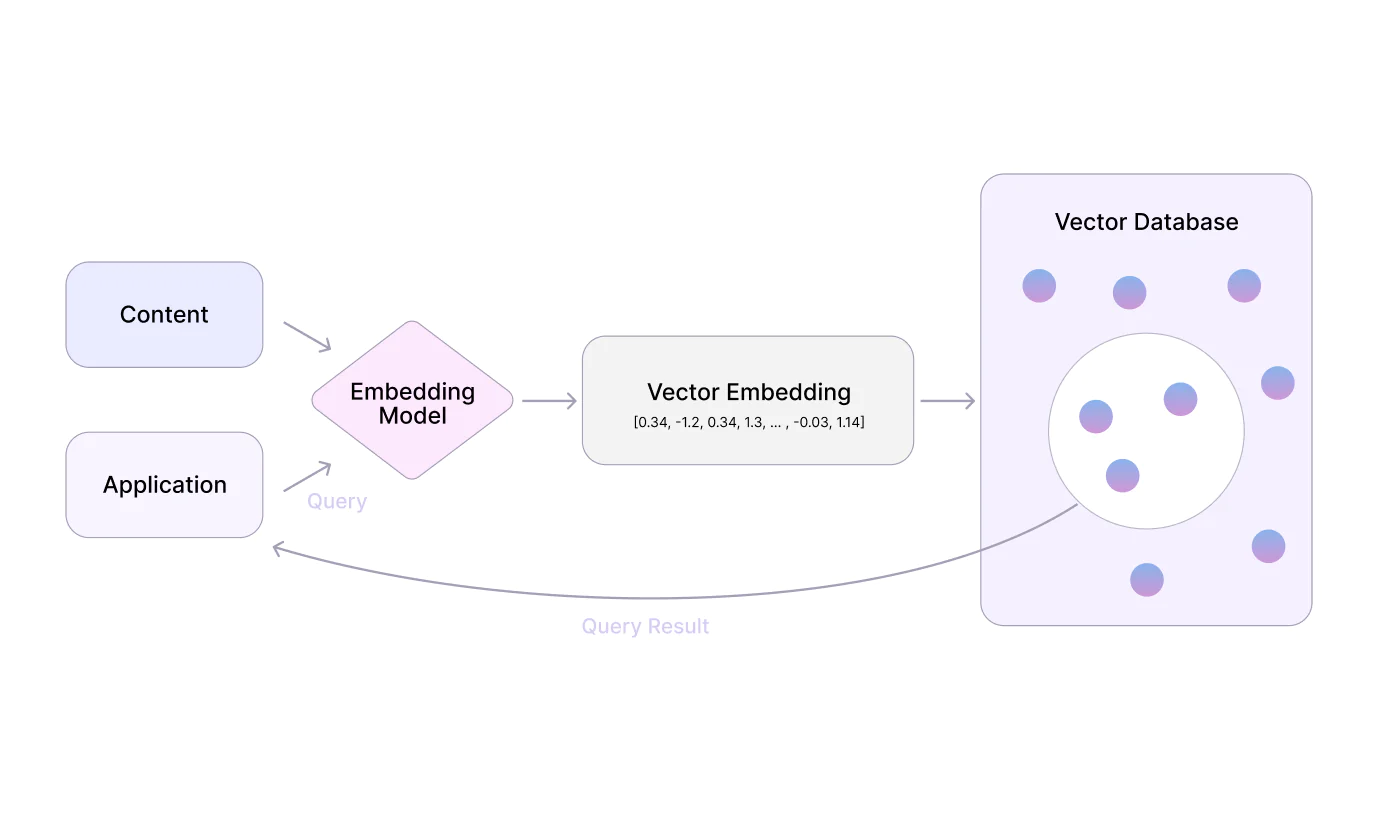
Let’s start with vector embeddings, a type of data representation used by generative AI, Natural Language Models, and semantic search. In very simple words, it works like this:

  • AI generates vector embeddings infusing them with various attributes and features.
  • Features of embeddings represent patterns, relationships, and structures of data. They are what enables AI to “understand” content and context.
  • Traditional scalar-based databases aren’t the best fit for working with these embeddings because they can’t keep up with their complexity.
  • Vector databases are designed to work with vector embeddings. Therefore, they offer the highest levels of productivity and flexibility.
  • Using these databases allows AI to develop long-term memory and execute more complex tasks.

The picture below shows a basic representation of how a vector database works with vector embeddings. Notice how the database identifies similar embeddings associated with original content. This allows it to be faster and more productive in handling data.

How custom AI solutions refere to vector databases through embeddings.

How Does a Vector Database Work?

To understand why exactly vector databases are better for custom AI solutions, you need to know how they differ from other options. Traditional scalar databases store data in rows and columns. That’s pretty straightforward, secure, and efficient, but these rows and columns can be hard for AI to navigate. Even with immense processing power, identifying and reaching the needed data takes a lot of time.

Meanwhile, vector databases are different in their methods of data optimization and querying. Instead of querying a row with a perfect value match, vector databases use a similarity metric. Therefore, they are searching for a vector most similar to your query. To achieve this, they use a variety of algorithms combined into ANN (Approximate Nearest Neighbor) search. To optimize the search, these algorithms use:

  • Hashing
  • Quantization
  • Graph-based search

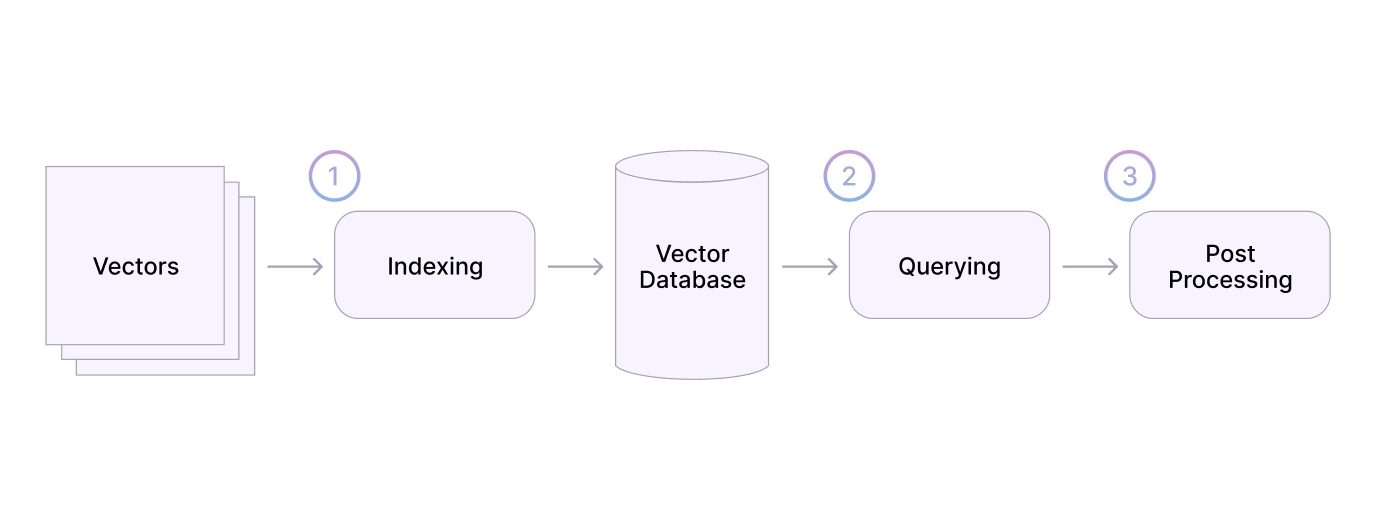
Boosting custom AI solutions: vector database pipeline.

The vector database pipeline (shown above) allows searching for information extremely fast. However, due to using ANN, the results you get are approximate. So, when working with this type of database, you need to understand that accuracy and speed are interdependent. It means that to get greater accuracy of results, you must lose speed.

That said, a good vector database, when used by custom AI solutions, should work so well that you get ultra-fast and ultra-accurate results.

Here’s how it goes step-by-step:

  1. Indexing
    The database indexes vectors using PQ, HNSW, LSH, and some other algorithms. It’s a mapping step that helps speed up the search.
  2. Querying
    The database compares indexed queries to the indexed vectors within the dataset to identify ‘nearest neighbors’.
  3. Post processing
    When needed, the database will retrieve the nearest neighbors and process them to achieve the final result with the highest accuracy.

How vector databases benefit custom AI solutions in real life.

Top Vector Databases for Custom AI Solutions Available Today

Devtorium’s software engineers working with custom AI solutions researched vector databases available today and selected the ones they consider the most efficient and promising.

  • Chroma DB
    It’s an open-source embedding database. Chroma lets developers add state and memory to their AI-enabled apps. It comes with everything a developer needs to store, embed, and query data, including built-in filtering, automatic clustering, and query relevance. It has both Python and typescript APIs, native support for OpenAI, and auto support for LangChain.
  • Pinecone
    This vector database makes it easy to build high-performance search apps. Pinecone finds and retrieves vectors, handles large amounts of data, detects irregularities and patterns in datasets, works well with the text, and can identify unusual behavior in time-series data.
  • Weaviate
    It’s an open-source vector database that allows you to store data objects and vector embeddings from various ML models. It scales seamlessly into billions of data objects. Weaviate offers semantic search, flexible schemas, time series analysis, and integration with deep learning frameworks.

How to Use Vector Databases in AI Solutions for Business

If you feel a little lost in all these technicalities and want to know exactly why you should consider using vector databases in custom AI solutions, see how they apply in real life.

  • Recommendation systems
    Providing personalized suggestions on your website certainly increases sales.
  • Searching for images and text
    Converting text and images into vectors makes finding similar ones easier. That’s especially useful in eCommerce, where customers can search for items using descriptions or photos. 
  • Natural language processing
    Representing words and sentences as vectors makes it easier for AI to understand and interpret human language. You can use this in document clustering and semantic search to increase accuracy. 
  • Fraud detection
    Vector databases can be applied to find data patterns that point to fraud. For example, a specific set of transactions with similar vector representations might alert your security system.

In the nearest future, a successful business will be one that effectively harnesses the potential of AI. At Devtorioum, we know multiple ways to boost the power of custom AI solutions. If you plan on gaining an advantage over competitors using one of these, contact us for a free consultation!

What Are Data Science Services?

Data rules the world today, and data science services can be a true game-changer for any business. However, few business owners realize the potential and versatility of data science as a service. It’s regrettable, especially for SMBs and startups, which can benefit tremendously from the insight derived from big data.

Today we’ll try to remedy this situation and expand on the subject of why now is the time for data analytics. We’ll start by explaining how some basic data science consulting services can help businesses thrive in competitive and volatile markets.

Data Science Services Explained

Data science services: mining, processing, and data analytics

Data Mining, Processing & Visualization

The first among data analytics consulting services is data mining. Simply put, the team will find a way to extract all the information you require from any source. This type of service is highly versatile because the type of data that businesses need to process might vary considerably. For example, in one of our cases, data scientists had to develop a method and solution to extract patient information from multiple sources, including healthcare system records and even doctors’ handwritten notes.

Then, the collected data will be translated into some universal format and processed. Depending on the volume, the team might require substantial resources to complete these tasks. Using the help of NLP (Natural Language Processing) tools is quite common when processing and analyzing data.

Data science visualization services allow the client to get the data presented in a manner they can easily use for business. For example, an eCommerce business can get detailed reports on sales dynamics during a specific period. Based on this report, the client will be able to understand exactly how people choose to spend money on their website. Therefore, they will be able to come up with more efficient offers to boost sales.

Predictive Analytics, Forecasting, Risk Management & Optimization

Big Data analytics is a type of service that can benefit any business because it’s your way to get information about the market. Therefore, it enables you to make well-informed decisions that will provide better results.

Data science services allow you to use the tremendous storage of valuable insights that is the Big Data to make accurate predictions to build your business strategy. Predictive analytics works by building NLP models that analyze specific types of situations on the market, identify patterns, and make forecasts based on them.

Data science services that involve forecasting can provide a highly accurate future development model. For a business, such prediction can help reduce risks and prepare for those that are unavailable. In addition, predictive data analytics models can be used as a strong argument for investors.

Another way to implement data science services is to have the team provide an optimization plan for your business. Then, they will use a combination of data mining, processing, analysis, and forecasting to develop a set of custom-tailored recommendations for your business.

The best thing is that such recommendations are based on actual data and existing patterns. Therefore, your company won’t waste money on changes that won’t have a positive impact in the long run. When you rely on data science services, all results are based on hard evidence, so risks are minimal.

Data science services powered by AI: predictive modeling in data analytics.

NLP, Computer Vision, AI & Machine Learning

Are you wondering how exactly data scientists do the analytics and prediction part of their work? The answer is they use AI to assist them in these processes. The exact technology they use varies based on the task. For example, a data science team can build a very primitive NLP model to ‘mine’ information matching specific parameters from a particular database.

However, they can also use the same technology on a grander scale to build a more complicated model to analyze specific patterns, like market growth trends. Then, another model will process that data and make a forecast based on those patterns accounting for additional factors.

AI technologies are developing rapidly, and so are data science services. Therefore, the scope of insights you can derive from this service increases, giving you new business opportunities.

Another exciting type of AI-based service a data science team can offer is utilizing computer vision technology. Like NLP models derive information from textual data, computer vision extracts information from the visuals. The most common application for this tech now is the facial recognition feature used by multiple gadgets. However, on a larger scope, this technology can be used to prevent crime, analyze a stream of video footage, or monitor specific areas for emergencies.

What Businesses Need Data Science Services?

Applications of AI and data science services are endless. So, regardless of size, every business can benefit from using these services on any level. Therefore, the main factors to consider are your budget and goals.

First, determine what it is that you’d like to achieve at this stage. Do you want to cut costs? Optimize business processes to increase productivity? Enter a new market? Launch an innovative startup? Expand the capabilities of your existing product? Enhance your business strategy?

Once you’ve chosen one or several objectives, book a meeting to discuss data science consulting services. A team of experts will analyze your business and request and develop a list of services that will help achieve your goals.

Contact us and set up a free meeting today!

Data Science Services: Introducing CRISP_DM

Data science services are fast becoming the most in-demand type of business service. It’s because business owners understand that it’s impossible to succeed in modern extremely competitive markets without having an extra edge. Data analytics is the most effective way to get that edge. But it’s also important to understand that it’s a highly complex subject. So, any company that wants to get valuable insights needs to know exactly how data mining and analytics work.

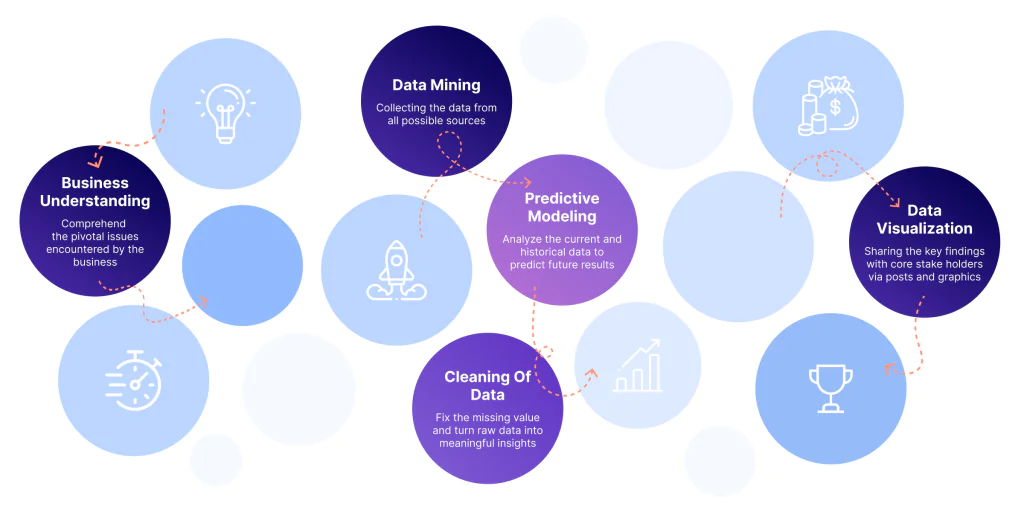
Modern data science services are based on a methodology called CRISP_DM, which stands for a cross-industry standard process for data mining. It’s a cycle of processes that allows data analytics professionals to set and achieve goals. This process can be ongoing, continuously circling back to the first step and setting new goals as the project grows.

Data Science Services Breakdown: CRISP_DM Methodology

Business Understanding

The primary task of the data professional at this stage is to define exact project goals. The goal is to develop a deep understanding of the client’s needs and requirements. Business understanding goes hand in hand with project planning.

This step is crucial because building a strong foundation of business understanding is imperative before you start data mining. The process goes like this:

  1. Understand the client’s business objectives and how they can be achieved.
  2. Perform a thorough assessment of the situation by analyzing available resources, requirements, risks, contingencies, costs, and benefits.
  3. Define exact goals for the data mining process that correlate with the project goals.
  4. Create a detailed plan that describes each phase of the project and lists all necessary tools and technologies.

Data Understanding

The data understanding phase enhances the previous by defining the data sets needed to accomplish the client’s business goals. Data scientists need to complete four tasks at this stage.

  1. Collecting initial data and loading it into analytics tools.
  2. Examining the data and documenting its properties as required.
  3. Exploring the data: query, visualize, and determine relationships between separate pieces of data.
  4. Verifying the data quality and documenting it.

Data Preparation

Data preparation is the most time-consuming task in the entirety of data science services. It takes up about 80% of the data professional’s time working on a project. The quality of preparation is the crucial factor that defines analytics accuracy. This stage consists of five tasks:

  1. Choosing data sets that need to be used and documenting reasons for these choices.
  2. Cleaning the data: correcting, imputing, or removing erroneous values.
  3. Constructing data by deriving new useful attributes.
  4. Integrating data by combining multiple data sets from different sources.
  5. Formatting or reformatting data as necessary.

CRISP DM methodology applied in data science services.

Modeling

Surprisingly, data modeling often takes the least amount of time among data science services. However, it can’t be completed without the lengthy preparation of the previous step. During this stage, data scientists create and assess models until they find the one that’s ‘good enough’. However, the entire CRISP_DM process must go through several iterations so the end model is ‘the best that could be’.

The modeling process consists of four steps:

  1. Choosing modeling techniques, for example, which algorithms to use.
  2. Creating a test design for modeling.
  3. Building models.
  4. Assessing each model and comparing them against each other based on test design domain knowledge and success criteria that are set at the beginning.

Evaluation

The evaluation stage is similar to the model assessment step of the previous stage. However, the evaluation goes deeper and considers not the technical aspects of the model but how it meets the business’ needs. The evaluation consists of three integral steps:

  1. Evaluating the model results based on business success criteria defined in project requirements.
  2. Reviewing the work to make sure nothing was missed. The findings are summarized, corrected if necessary, and documented.
  3. Making decisions about the following steps based on the collected data. There are three choices: deployment, further iteration, or initiating new projects.

Deployment

The project requirements define the exact process of deployment. It can differ greatly from generating a report to establishing a repeatable data mining process. At this stage, the customer must be able to access and use the model’s results. To that end, data science service providers must complete several steps:

  1. Create and document a deployment plan.
  2. Develop a plan for model monitoring and maintenance, depending on project requirements.
  3. Develop a final report that summarizes the entire project and includes a presentation of data mining results.
  4. Review the whole project, determining what went well and what could have gone better to develop plans for future improvements.

How Data Science Services Help Businesses

The primary purpose of data science services is to help the decision-making process of the business. Different types of data analytics can provide a variety of predictions that clients can use for development and growth. It’s also invaluable for risk assessment and decisions about expanding to new markets.

Data analytics works best when combining AI’s ability to process vast masses of information and human intelligence that can see the best ways to implement data mining results. If you want to find out how this works and what value your business can get from analytics, contact our data science team for a free consultation!

How to Use an AI-Powered Platform to Make Data-Driven Decisions

Advanced robots, self-driving cars, automated delivery bots, Internet of Things, and all the other cool and sexy tech we have today all run on some kind of an AI-powered platform. But those platforms only exist because of data. Data analytics is at the heart of AI, business, and the world as a whole today. So, if you want to get ahead, you must wield its immense power for making business decisions. However, the human brain cannot compute such enormous blocks of information. So, you’ll need to use a SaaS analytics platform to do it for you.


How to Use an AI-Powered Platform to Improve Your Decision Making

The best thing about Big Data is that it holds the answers to all your questions. Actually, it can even predict the future if used right. And that means ‘if it’s processed by an AI-powered platform geared toward predictive analysis.’

No business today can survive without data analytics. It’s because you literally can’t make decisions without the insights derived from data. You might only rely on your monthly business reports or go for a broader scope including global economic reports. But the point is that you have to make decisions based on something more concrete than your intuition. It means understanding what types of data analytics exist. And more importantly, how to use them at different stages of decision making.


Types of Data Analytics Performed by an AI-Powered Platform


Descriptive

Descriptive data analytics provides you with answers to the question “What happened?” In essence, you can use this data to understand how your business is doing. Then, depending on how deeply you analyze various processes, you can decide which areas to focus on.

There is no doubt that these insights from a basic AI-powered platform are extremely beneficial. They are especially handy when you need to identify areas where you can cut costs.

That said, descriptive analytics insights are somewhat limited. They only give you information about your past business performance and don’t consider any outside factors affecting it.


Diagnostic

Diagnostic data analytics is used to understand why something happened. Performing this analysis is the logical next step after collecting descriptive data insights. At this point, the AI-powered platform can delve deeper and understand why some of your business decisions failed or succeeded.

Bear in mind that diagnostic analytics will require a wider scope of data than your internal business reports. Also, it will be, at least somewhat, based on conjecture. It’s hardly possible to account for all potential factors that affect any business outcome. Therefore, you’ll have to accept that while highly valuable, these insights are also not absolute.


Predictive

Predictive analytics is far more advanced and requires the implementation of an AI-powered platform. Machine learning, in particular, is the basis of any successful predictive analytics. Insights derived from it allow you to see what is likely to happen shortly. Therefore, you can use them to make decisions that might propel your business forward.

This kind of prediction for future trends is most valuable for businesses that want to grow. However, any forecasts cannot be 100% accurate. There are just too many factors that are beyond your control that affect the outcome. Many of these factors are macroeconomic and volatile.

Bearing that in mind, you should use predictive analytics to develop a proactive approach to business. It can help you plan, especially for the situations that might affect you in the future. Thereby they help your business prepare for potential challenges.


Prescriptive

Prescriptive data analytics is the most advanced type, and it can provide the most valuable insights. At this state, an AI-powered platform will aim to give you guidance on what actions you can take. To get the most value from these insights, you need to have specific questions in mind. Then, analyzing your goals and data will enable the AI to determine the actions necessary to achieve your desired results. These insights are primarily based on the data obtained from predictive, descriptive, and diagnostic analyses.

However, prescriptive analytics will also use technology like simulation analysis to discover solutions to potential or current problems. Of course, these solutions are subject to the same limitations as any predictive analysis. But they are highly valuable as they enable you to reduce risks that are inherent to any business.


Implementing Insights Delivered by an AI-Powered Platform

Studying a real-life example is the best way to understand how an AI-powered platform can benefit your business. Marquètte is a piece of SaaS data analytics software developed by Devtorium and powered by proprietary AI tech. It uses a combination of data analytics methods and technology to conduct a SWOT and PESTEL analysis of any field.

On the user side, this looks like you are conducting a simple internet search. However, in reality, AI goes through huge blocks of data in order to find concrete answers to your questions. So, when it’s done its job, you get a summary that answers your question in detail and includes actionable insights. Then, as a business owner, you can put those into action right away. Thus, you ensure your company derives maximum benefit from the information.

Businesses can use the insights provided by Marquètte to:


  • Revamp your brand design for increased impact
  • Find new areas for your business to expand in
  • Predict challenges your company needs to prepare for
  • Adjust your marketing strategy for maximum efficiency
  • Answer any industry and niche-specific questions you have
  • Forecast business development when planning for the future

As you can see, an AI-powered platform is an invaluable ally for any business. So, the only question is whether you want to use an existing solution, like Marquètte, or to have custom SaaS data analytics software developed for you.

cookie-image
cookie-image-mobile

Our website uses cookies

We use cookies and share information about your use of our site with our social media, advertising and analytics partners who may combine it with other information that you’ve provided them.