



Table of contents
Understanding the DISC Model: A Key to Effective Workplace Communication and Team Management
At Devtorium, our PMO stays ahead of the latest trends in project management, team dynamics, digital transformation, and business excellence. Each month, our team hosts knowledge transfer calls to share insights on new project-related topics.
In today’s fast-paced and collaborative work environments, especially in IT and tech-driven industries, understanding the personalities and communication styles of your team can make a significant difference in productivity, engagement, and overall team dynamics. One of the most widely used frameworks to achieve this understanding is the DISC Model.
Alona Bochkarova, Head of BA at Devtorium, explained how the DISC model enhances teamwork and enables project managers to deliver outstanding results. In this article, we’ll explore how we apply DISC in our projects and why it’s essential for building high-performing teams.
What is the DISC Model?

The DISC model is a behavioral assessment tool that categorizes human personalities into four primary types: Dominance (D), Influence (I), Steadiness (S), and Conscientiousness (C). Developed from the research of psychologist William Moulton Marston in the 1920s, DISC is based on the idea that behavior and communication preferences can be understood, predicted, and adapted for more effective interactions.
Unlike personality tests that try to define who someone is, the DISC model focuses on how someone behaves in different situations. This makes it particularly practical for professional settings, where understanding behavior can improve teamwork, leadership, and project outcomes.
The Rising Relevance of DISC in Tech Teams
In modern workplaces, team success depends on collaboration across diverse roles and skill sets. Developers, project managers, UX designers, and support staff all have different ways of approaching tasks, solving problems, and interacting with colleagues. Miscommunication or misunderstandings can slow down projects and create conflict.
Here’s why DISC is increasingly relevant:
- Remote & Hybrid Work: With teams distributed globally, understanding communication styles is essential to maintaining cohesion and productivity.
- Cross-Functional Teams: IT projects often require collaboration between developers, QA, designers, and business analysts, each with different priorities and working styles.
- Leadership Development: Managers who understand DISC can better motivate, delegate, and guide their teams.
- Employee Engagement & Retention: Create a supportive environment that recognizes different working styles.
DISC Profiles: Understanding the Four Key Types

1. Dominance (D)
- Traits: Direct, results-oriented, strong-willed, forceful
- Strengths: Decisive, quick decision-making, leadership in challenging situations
- Potential Challenges: Can appear intimidating or overly assertive
2. Influence (I)
- Traits: Outgoing, enthusiastic, optimistic, lively
- Strengths: Inspires others, energizes teams, and is excellent in client interactions
- Potential Challenges: May be overly optimistic or overlook details
3. Steadiness (S)
- Traits: Even-tempered, patient, humble, tactful
- Strengths: Great team support, consistent, empathetic
- Potential Challenges: May appear indecisive or resistant to change
4. Conscientiousness (C)
- Traits: Analytical, precise, systematic, reserved
- Strengths: Attention to detail, problem-solving, compliance with rules
- Potential Challenges: Can overanalyze and slow down decision-making
People-Oriented vs. Task-Oriented
- People-oriented: I and S types tend to prioritize relationships and team cohesion.
- Task-oriented: D and C types focus more on results, efficiency, and quality.
- Outgoing and Inspiring: I types naturally, energize and motivate those around them.
How the DISC Model Influences Modern Workplace Strategies
- Improving Communication: Tailor your approach – be direct for D types, enthusiastic for I types, supportive for S types, and precise for C types. This ensures everyone stays on the same page.
- Enhancing Team Dynamics: Understanding how different personalities interact helps teams balance their strengths and address potential areas of friction. For example, pairing a decisive D with a methodical C can create a team that acts quickly while maintaining high accuracy.
- Leadership Development: DISC provides leaders with insights to adapt their approach for each team member. Knowing whether someone is task-oriented, people-focused, or analytical allows managers to guide, motivate, and support their team more effectively.
- Conflict Resolution: By recognizing personality-driven differences, managers can identify the root of disagreements and mediate constructively.
- Employee Engagement: Create an environment where all types feel valued. Aligning roles with natural strengths and acknowledging different working styles boosts motivation and satisfaction.
- Facilitating Change Management: Different personalities react to change differently; DISC helps anticipate resistance and support adaptation.
DISC in Action: Optimizing IT Team Performance
- Understanding Team Dynamics: A mix of D and C blends decisiveness with analysis, while high I types energize the group. Recognizing these interactions allows project managers to create balanced, high-performing teams.
- Tailoring Communication Styles:
- D: Direct and concise
- I: Friendly and collaborative
- S: Supportive and empathetic
- C: Detailed and structured
- Aligning Roles with Strengths: Assign tasks according to natural strengths for maximum efficiency.
- Facilitating Conflict Resolution: Recognize differing decision-making styles and mediate accordingly.
- Promoting Continuous Development: Provide training and growth opportunities tailored to DISC profiles.
Best Practices for Communicating with Each DISC Type
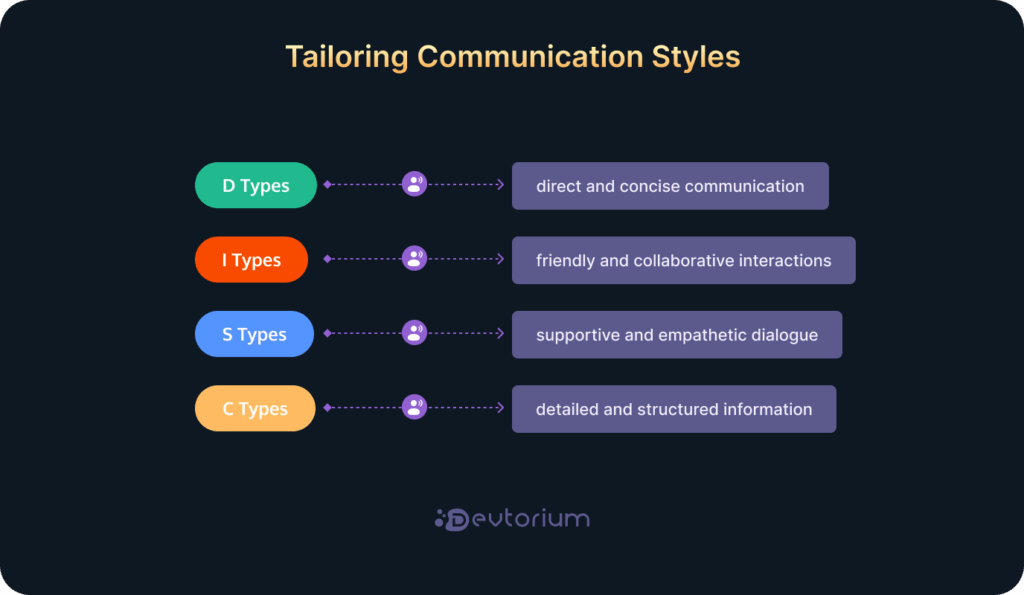
D: Be direct, encourage decision-making, focus on objectives, limit emotional content
I: Maintain enthusiasm, encourage self-expression, focus on the big picture, and recognize achievements
S: Create a safe environment, allow reflection, use specific questions, and show genuine interest
C: Be detailed and structured, stick to facts, clarify expectations, encourage thorough analysis
Identifying DISC Profiles in Your Team
- Observe Behavioral Traits: Look at pace, assertiveness, and social interaction.
- Analyze Communication Style: Is it formal, friendly, analytical, or empathetic?
- Identify Emotional Expressions: Warmth vs. Skepticism, Optimism vs. Caution.
- Formal Assessment: DISC assessments can provide reliable insights.
Two Key Questions:
- Is this person fast-paced and outspoken, or cautious and reflective?
- Are they questioning/skeptical or warm/accepting?
Quick Guide:
- Fast-paced & outspoken + Questioning/Skeptical = D Style
- Fast-paced & outspoken + Warm/Accepting = I Style
- Cautious & reflective + Warm/Accepting = S Style
- Cautious & reflective + Questioning/Skeptical = C Style
Conclusion: Boost Team Performance with DISC
The DISC model is a powerful tool for improving communication, teamwork, and project success. By understanding personality styles, project managers can assign tasks wisely, resolve conflicts faster, and foster a motivated, high-performing team.
Start applying DISC today: observe behaviors, adapt your communication, and align roles with strengths – small changes can have a significant impact on team performance and project outcomes.


