



Table of contents
As someone passionate about healthcare innovation, I’ve been closely following the challenges startups face in this sector and have identified critical patterns worth sharing. Studies show that 80% of healthcare technology startups fail, not from a lack of innovation, but from building products that don’t address real market needs. The success of any healthcare solution hinges on three critical factors: demonstrating value quickly, maintaining regulatory compliance, and meeting the specific needs of both patients and healthcare providers. This is where strategic healthcare MVP development becomes essential.
Whether you’re launching a telemedicine platform, a chronic care management app, or a hospital workflow automation tool, in this article, I’ll share practical insights on how to build an MVP for a healthcare app that attracts investors, demonstrates measurable impact, and significantly reduces early-stage product development risks.
Why MVPs Are Crucial for Healthcare Innovation
Healthcare product development operates under constraints that differ from consumer technology. When you build an MVP for a healthcare app, you’re navigating a complex ecosystem of regulatory requirements, clinical safety standards, and deeply entrenched workflows that resist change.
The financial and regulatory stakes in healthcare are substantially higher. GDPR violations can result in fines up to €20 million or 4% of annual global revenue, whichever is higher. HIPAA penalties range from $141 to $71,162 per violation, with an annual cap of $2,134,831. A single compliance misstep can trigger regulatory investigations that effectively terminate operations before they begin.
Beyond regulatory considerations, healthcare MVPs must address a unique challenge: proving clinical efficacy alongside technological functionality. Investors and early adopters in healthcare don’t evaluate products based solely on user experience or feature sets. They require evidence of measurable clinical outcomes, workflow efficiency improvements, or cost reductions.
MVPs allow founders to validate both technical performance and clinical value without committing capital to full-scale development. An MVP approach allows you to test critical hypotheses about user adoption, clinical workflows, and value propositions before investing in features that may prove unnecessary or ineffective.
Key Features Every Healthcare MVP Should Include
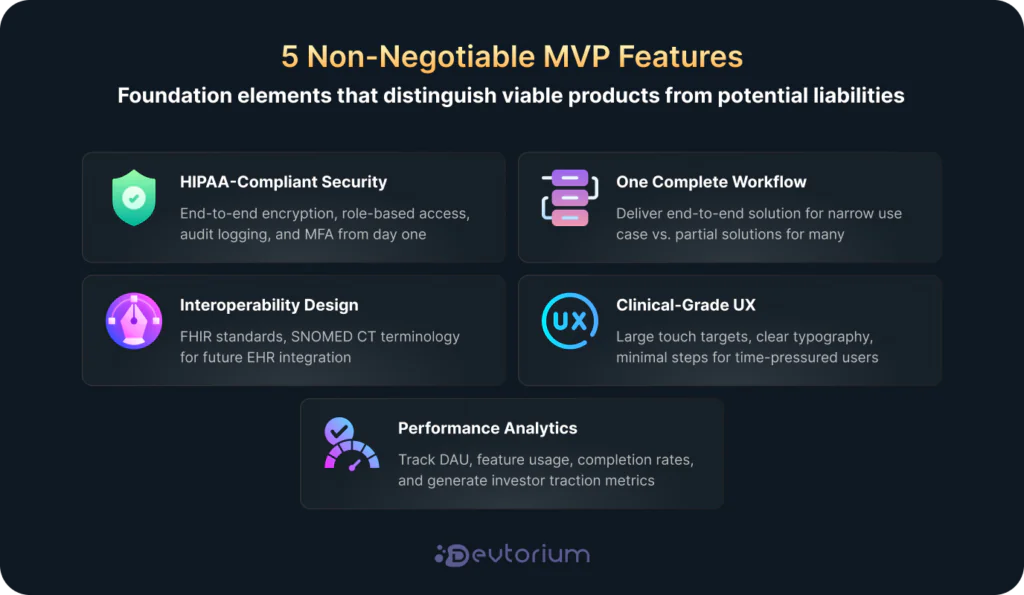
When developing a healthcare MVP, certain capabilities are non-negotiable. These foundational elements distinguish a viable healthcare product from a potential liability.
HIPAA-Compliant Security Architecture
Security must be embedded in your product architecture from inception, not added as an afterthought. Your MVP requires end-to-end encryption for data in transit and at rest, role-based access controls that restrict data visibility by user type, comprehensive audit logging that tracks all data access and modifications, secure authentication including multi-factor authentication options, and automated backup systems with documented disaster recovery procedures.
These security measures aren’t optional features for future releases; they represent the minimum acceptable standard for any application handling protected health information (PHI).
One Complete Clinical Workflow
The most common mistake in healthcare MVP development is trying to solve too many problems at once. Instead, focus on delivering one complete clinical workflow exceptionally well.
The key principle: deliver a complete, end-to-end solution for a narrow use case rather than partial solutions for multiple use cases. Hospitals and clinics evaluate tools based on concrete return on investment, measurable workflow efficiency improvements, and demonstrated clinical outcomes. One thoroughly validated workflow provides more value than multiple incomplete features.
Interoperability by Design
While your MVP may not require full electronic health record (EHR) integration at launch, its architecture must support future interoperability. Implement standard data formats such as FHIR (Fast Healthcare Interoperability Resources) from the beginning. Design your database schema to support standardized medical terminology, such as SNOMED CT or LOINC codes.
This approach preserves long-term flexibility. Healthcare products rarely remain limited to their original scope – wellness platforms often integrate with clinical systems, and patient engagement tools frequently expand into diagnostic or decision-support use cases. Designing for interoperability early avoids costly infrastructure changes later and supports smoother product evolution.
Clinically Appropriate User Experience
Healthcare applications serve users with very different needs and working conditions. Your interface must support clinicians operating under time pressure, older patients with accessibility challenges, and physicians navigating short appointment windows.
Effective healthcare MVPs prioritize usability: large touch targets, clear typography, minimal steps for critical actions, and simple, plain-language error messages. Thoughtful UX design directly impacts adoption and clinical efficiency.
Analytics and Performance Metrics
From your initial release, implement comprehensive analytics to understand user behavior and demonstrate value to stakeholders. Essential metrics include daily and weekly active user counts; feature utilization patterns that reveal which capabilities users actually use; workflow completion rates that indicate where users encounter friction; time-to-complete measurements for critical clinical tasks; and error rates by function to identify usability problems.
These analytics serve dual purposes: they provide the data needed for iterative product improvement and generate the traction metrics investors require when evaluating funding opportunities.
AI-Powered Features in Healthcare MVPs
Some healthcare MVPs benefit from early AI testing, such as risk scoring for patient triage, symptom checkers, or automated scheduling. Testing these features at the MVP stage helps answer critical questions: Is your data sufficient? Does the AI improve clinical decisions? Will users trust it?
Validate AI capabilities early to assess feasibility and clinical relevance before committing to broader AI software development initiatives. Start simple, measure impact, then expand based on proven value.
Common Mistakes to Avoid in Healthcare MVP Development
Understanding common failure patterns in healthcare MVP development can help you avoid expensive mistakes and timeline delays.
Ignoring Compliance in Early Development
The most costly mistake is treating regulatory compliance as something to address after proving product-market fit. If your application handles PHI, HIPAA-grade controls must be implemented from day one. Rebuilding a non-compliant application later is more expensive than building it correctly from the start.
Smart founders include early legal review, secure data architecture by design, compliant consent workflows before collecting any patient data, and establishing Business Associate Agreements before processing health information.
Building Without Clinical Input
Healthcare workflows contain nuances that are invisible to technology teams without clinical backgrounds. What seems intuitive to developers may be completely unusable for actual healthcare providers or patients.
Establish a clinical advisory group of 5 – 7 individuals representing your target users. Conduct weekly reviews where you share work-in-progress and gather systematic feedback. When multiple advisors independently identify the same usability issue, that signals a problem requiring immediate attention.
Attempting to Solve Too Many Problems
The temptation to build a comprehensive platform from the start undermines the core MVP philosophy. Use rigorous prioritization frameworks, such as MoSCoW (Must have, Should have, Could have, Won’t have), to identify your absolute minimum feature set.
For a telehealth platform, “must-have” features might include secure video connections, basic patient intake forms, appointment scheduling, and HIPAA-compliant messaging. All other capabilities, such as prescription management, laboratory result integration, and comprehensive billing, should be included in subsequent releases.
Underestimating Change Management Requirements
Healthcare environments are notoriously resistant to workflow modifications. Your pitch to investors should acknowledge this reality and articulate your specific strategy for driving adoption.
Successful healthcare startups often focus on one measurable metric, such as reducing documentation time or improving appointment show rates, rather than extensive feature lists. Investors respond to concrete evidence of efficiency gains backed by pilot data.
Unrealistic Implementation Timelines
Hospital procurement and implementation processes involve multiple stakeholders, extensive security reviews, staff training requirements, and workflow integration challenges. If your projections assume 30-day deployments, investors will question your understanding of the healthcare market.
Be realistic about timelines. A typical hospital deployment takes 90–120 days, including IT security assessments, compliance reviews, staff training, and gradual workflow integration. Setting conservative expectations and exceeding them builds credibility.
How to Validate Your Idea Before Scaling

The most expensive mistakes in healthcare MVP development occur when teams build solutions before validating that target users actually want them.
Define Your Target Market Precisely
Avoid attempting to serve everyone simultaneously. Define the narrowest possible market segment where you can definitively prove value. This specificity makes it substantially easier to identify pain points, develop targeted messaging, and demonstrate concrete ROI to early adopters.
Conduct Problem Discovery Interviews
Before writing code, conduct 20 – 30 in-depth interviews with individuals in your target segment. These are your learning opportunities. Understand current workflows and specific pain points, solutions they’ve previously attempted and why those failed, budget authority and decision-making processes, and concrete success criteria from their perspective.
Start with a Lightweight Prototype
Before building your full MVP, create the smallest possible version that tests your core hypothesis. This might be a clickable prototype with simulated data, a wizard-of-oz test in which humans perform functions the technology will eventually automate, a simplified version built with no-code platforms, or detailed specifications with interactive mockups.
Present this to potential users and observe their reactions that will provide invaluable signals about product-market fit before you’ve invested in full development.
Structure Paid Pilot Programs
The ultimate validation is whether someone will pay for your solution. Structure initial deployments as formal pilot programs with clear terms and conditions. Offer discounts, but establish genuine business relationships with written agreements.
Even small payments validate that users see genuine value and provide crucial data on pricing strategy.
Real Examples: Successful Healthcare MVPs in 2025 – 2026
Examining recent success stories illustrates how effective MVP strategies translate into market traction and funding.
Telehealth Platforms. Startups using MVP approaches achieve 70% success rates, compared with 50% for those that skip this validation phase. MVP telehealth applications typically cost $55,000 – $95,000 and have 3 – 4-month development timelines. Platforms focused on a single specialty gained traction faster than broad, general-purpose solutions. Teladoc, now serving over 55 million members across 175+ countries, began with a narrow set of use cases before expanding.
Mental Health Applications. A mental wellness platform that integrates with patient management systems achieved 75% higher user engagement than traditional digital health tools, with patient anxiety levels dropping 40% within three months. The secret? Focusing on personalized coping strategies while maintaining strict privacy standards. Mental health startups raised $682 million in the first half of 2024, with winners starting from tightly scoped MVPs.
Maternal Health Solutions. Several maternal health startups secured major funding in 2025 by starting narrow. The most successful approach focuses on perfecting a single, complete workflow, such as continuous prenatal care with tracking and education, before expanding into broader women’s health services.
Women’s Health Innovation. Two applications supporting mental health during pregnancy and motherhood won a global innovation award for women’s health in December 2025. The NVP Minds application helps pregnant women manage severe nausea, while HearHer supports mothers of children with mental health or developmental challenges. Both began as focused MVPs and now have NHS support for pilot sites and evidence generation, demonstrating how successful MVPs open the door to major institutional partnerships.
These examples share a common pattern: start narrow, prove value in one area, then expand with validated insights and institutional backing.
Conclusion: From MVP To Market Success
Healthcare MVP development focuses resources on what matters most and proves your concept works before committing to a full-scale investment. When you build an MVP for a healthcare app correctly, you create a foundation for sustainable growth, investor confidence, and real clinical impact.
Your healthcare MVP is your opportunity to prove your vision works without betting everything on immediate perfection. Build with compliance from day one. Launch with users who genuinely need your solution. Measure meaningful outcomes, iterate based on evidence, and scale with validated insights.
The healthcare system needs thoughtful, well-validated innovations that prioritize patient safety and clinical efficacy. That’s what well-executed healthcare MVP development delivers and why investors and early adopters respond when you get it right.
Planning to Build a Healthcare MVP?
Work with a team that understands healthcare regulations, adoption challenges, and scalable product architecture. With the right approach to MVP software development, organizations can validate ideas faster, reduce compliance risks, and build a strong foundation for long-term growth.
Schedule a free consultation to discuss how we can help you build and validate your healthcare MVP without unnecessary risk or wasted investment.


