



Table of contents
Software is the invisible polluter of the modern economy. Of course, we don’t see the exhaust pipes, but the carbon footprint of a poorly optimized data pipeline is very real.
In our previous discussion on AI Hallucinations, we explored how “invisible” errors in LLMs can quietly break an MVP’s budget. Today, a different invisible cost is hitting the C-suite: the carbon footprint of inefficient software.
As Large Language Models (LLMs) and massive data pipelines become standard infrastructure, energy consumption has shifted from an environmental concern to a core technical challenge. That’s exactly why Green Software Engineering (GSE) is becoming a required competency for modern teams and any forward-thinking software development company building scalable systems that minimize energy use and hardware load across the entire lifecycle, from the first line of code to the final UX interaction.
The Carbon Cost of Code No One Is Counting
Digital technology accounts for an estimated 3 – 4% of global greenhouse gas emissions, on par with or ahead of commercial aviation. Data centers alone consumed 415 TWh of electricity in 2024, and the IEA projects that figure will more than double to 945 TWh by 2030, which is higher than the entire electricity consumption of Japan, driven primarily by AI workloads.
Yet software teams are rarely asked to think about any of this. There’s no smoke, no exhaust – just electricity flowing into infrastructure and carbon dissolving somewhere inside a cloud invoice. The tools exist, the frameworks are proven, and here’s the part that surprises most engineering managers: carbon-efficient software is almost always faster and cheaper to operate.
Green software engineering is the discipline that changes how we design, build, and run systems to minimize energy use, reduce hardware load, and cut the carbon footprint across the full product lifecycle.
The Three Pillars of Green Software
Most engineering teams assume sustainable IT requires a dedicated initiative, a separate budget, or a new team. In reality, it does not. The Green Software Foundation defines six principles of sustainable software development, and three of them sit squarely inside what any standard engineering team already owns: the code, the infrastructure, and the scheduler.
You don’t need a dedicated sustainability team to get results. These principles live inside the daily workflow of any standard engineering team:
- Energy Efficiency: Write code that does less unnecessary work. Every redundant computation, every idle process, every over-provisioned instance burns electricity around the clock. Choosing energy-efficient algorithms and eliminating waste at the code level is the most direct carbon lever a developer controls.
- Hardware Efficiency: Extend hardware lifespan and maximize utilization, rather than driving premature replacement. Manufacturing a server generates significant carbon before it processes a single request, so software that runs efficiently on existing hardware helps defer that embodied cost. Keeping utilization high also reduces the need to spin up new instances on demand.
- Carbon Awareness: Run flexible workloads when and where the electricity grid is cleanest. The carbon intensity of electricity varies dramatically by time and region. A batch job scheduled at the right moment, in the right data center, can have a fraction of the footprint of the same job run without that consideration.

None of these requires a dedicated sustainability team or extra work. It requires owning the impact of your code, your infrastructure configuration, and your scheduling decision, which is just good engineering.
Technical Ownership: Engineering for Efficiency
The most direct control we have is the code itself. Different correct implementations of the same algorithm can vary in energy consumption by over 40%. Adopting energy-efficient algorithms isn’t just a performance decision at scale; it’s a carbon decision. This is the foundation of green coding practices that any team, especially an AI software development company working with large-scale data and models, can apply to any stack, in any language.
Beyond algorithms, the high-impact green coding practices are:
- Aggressive Caching and Data Minimization. Every byte moved between a client and a server carries an energy cost at both ends. Uncompressed assets, missing cache headers, and over-fetching APIs create a quiet waste that compounds quickly across millions of requests. Compress everything, cache aggressively, and return only what the caller actually needs.
- Event-Driven Patterns over Polling. A service polling an API every few seconds burns real CPU and network resources even when nothing has changed. WebSockets, server-sent events, and message queues eliminate that idle waste entirely and make your architecture more resilient in the process.
- Eliminating “Zombie Servers” through Right-Sizing. A server running at 10% utilization still draws 50 – 70% of peak power. These zombie instances are technically on but doing no useful work and are a simultaneous drain on the environment and the cloud budget. Autoscaling, scheduled scale-downs for dev environments, and regular audits of idle resources are the fix. The sustainability argument and the cost argument are identical.
Carbon-Aware Scheduling: Compute When the Grid Is Green
The carbon intensity of electricity – grams of CO₂ per kilowatt-hour – shifts constantly depending on how much renewable generation is on the grid at any given moment. It can vary by a factor of two or three within a single day in the same region, and far more across geographies. Renewable energy sources emit up to 20 times less CO₂ per kWh than coal. For batch jobs, training runs, and data pipelines, that gap is a carbon saving most teams have never thought to claim.
Temporal shifting means delaying batch jobs, training runs, and ETL pipelines until the grid is running cleaner. Spatial shifting means routing those jobs to the region with the lowest carbon intensity at that moment. A 2025 review of 28 research studies confirms both approaches consistently reduce carbon footprint with no impact on performance for flexible, non-latency-sensitive workloads.
The Green Software Foundation’s Carbon Aware SDK surfaces real-time grid intensity data for dozens of regions via API. Building a scheduling gate around it, deferring if intensity is above threshold, and releasing when it drops, is a few hours of engineering work. For Kubernetes teams, carbon-aware-keda-operator automates the decision entirely.
Immediate Impact: Tuning the Database
Audit your top database queries before anything else. Unindexed scans across millions of rows burn significant compute on every single request. Fixing N+1 patterns and adding missing indexes in an ORM-heavy codebase can immediately reduce database CPU usage by 30–50% without requiring architectural changes. It’s the highest-leverage green coding practice most teams haven’t done yet.
LLMs: The Biggest Energy Challenge in Modern Software
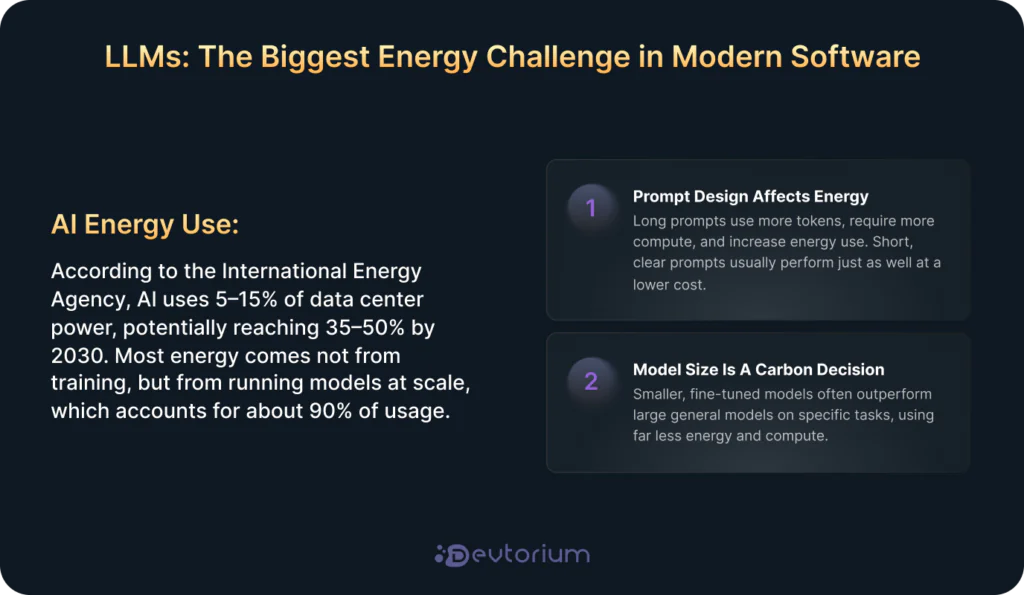
According to the International Energy Agency, AI has driven between 5 – 15% of global data center electricity demand in recent years, and that share could reach 35 – 50% by 2030. Training runs get the headlines, but they’re a one-time event. As LLMs move into production serving millions of daily queries, inference becomes the bill that never stops – according to AWS, it already accounts for nearly 90% of LLM energy consumption in live deployments.
Two things matter most for teams integrating LLMs:
- Prompt design affects energy. A longer, more verbose prompt generates more tokens, runs more compute, and costs more carbon per request. Short, specific prompts perform as well as verbose alternatives for most tasks at a measurably lower energy cost. Invoking chain-of-thought reasoning for a simple classification task is computationally wasteful at any scale.
- Model size is a carbon decision. A 7-billion-parameter (7B) model, roughly mid-size by today’s standards, fine-tuned on your domain data frequently outperforms a much larger general-purpose model on a focused task, at a fraction of the inference cost. Think customer support logs, legal documents, or product-specific content. Defaulting to the largest available model for every use case is an implicit carbon choice most teams haven’t consciously made.
Efficient LLM Fine-Tuning With LoRA
When fine-tuning is genuinely needed, full fine-tuning updating all model parameters is almost never the right starting point. LoRA (Low-Rank Adaptation) freezes the original model weights and trains only a small set of adapter matrices, typically reducing the number of trainable parameters by around 90%. In practice, a fine-tuning run that would cost $1,000+ with full fine-tuning can drop to under $5 on a single consumer GPU with LoRA while retaining over 90% of the quality of full fine-tuning, depending on the task.
Before committing to any training run, the decision should follow a clear order: prompt engineering first → RAG for knowledge-heavy tasks → LoRA/PEFT → quantization → full fine-tuning only when your evaluation metrics show that nothing else is sufficient to meet your requirements. This hierarchy isn’t just good sustainable software development practice – it’s good engineering economics.
Leaner Software, Lower Bills
Energy-efficient software costs less to run. Right-sized infrastructure cuts cloud bills. Carbon-aware scheduling shifts workloads to cheaper off-peak windows. LoRA costs less than full fine-tuning. The practices that shrink your carbon footprint also consistently reduce your operating costs – this is the core business case for carbon-efficient software, and it doesn’t require a sustainability mandate to justify.
The regulatory environment is also moving in one direction. The EU’s Corporate Sustainability Reporting Directive – even after the 2025 Omnibus update narrowed its scope will require companies with 1,000+ employees and €450M+ in turnover to disclose emissions across their full value chain, including digital operations, from financial year 2027. But aside from compliance deadlines, enterprise clients and large procurement teams are already asking suppliers to demonstrate their carbon footprints. Building that measurement capability now is significantly easier than doing it when a contract depends on it.
Starting with CodeCarbon, the Cloud Carbon Footprint project, or your cloud provider’s emissions dashboard, costs little and gives you the directional visibility you need to begin prioritizing. Sustainable IT starts with measurement. You don’t need perfection, you just need direction. The code has always had a carbon bill. The tools to start reading it have never been more accessible.
Want to reduce the carbon footprint of your software systems?
As a leading software development company, our team helps engineering organizations measure, prioritize, and act on sustainable software development without slowing delivery.


