



Table of contents
Remember when mobile banking was revolutionary? That was barely a decade ago. Now we’re standing at the edge of something much bigger, the time when generative AI is flipping the entire financial industry on its head. And it’s not about chatbots handling customer service calls. It’s about AI that can write code, predict market crashes before they happen, and spot fraudsters who haven’t even made their move yet.
And if you’re running a financial institution or building fintech products, you have two choices: adapt now or scramble to catch up later. In this blog, we explore how AI software development and generative AI solutions are reshaping FinTech in 2026 and what businesses need to know to stay competitive.
Decentralized Finance Meets Generative AI: A New Frontier
Decentralized Finance (DeFi) is no longer an experimental concept; it has matured rapidly, and 2026 marks the beginning of a new era: one in which decentralized systems become far more intelligent, adaptive, and responsive. With blockchain’s foundation secure, 2026 will see generative AI becoming the architect above it – designing adaptive smart contracts, rebalancing pools in real time, and predicting risk before the market even blinks.
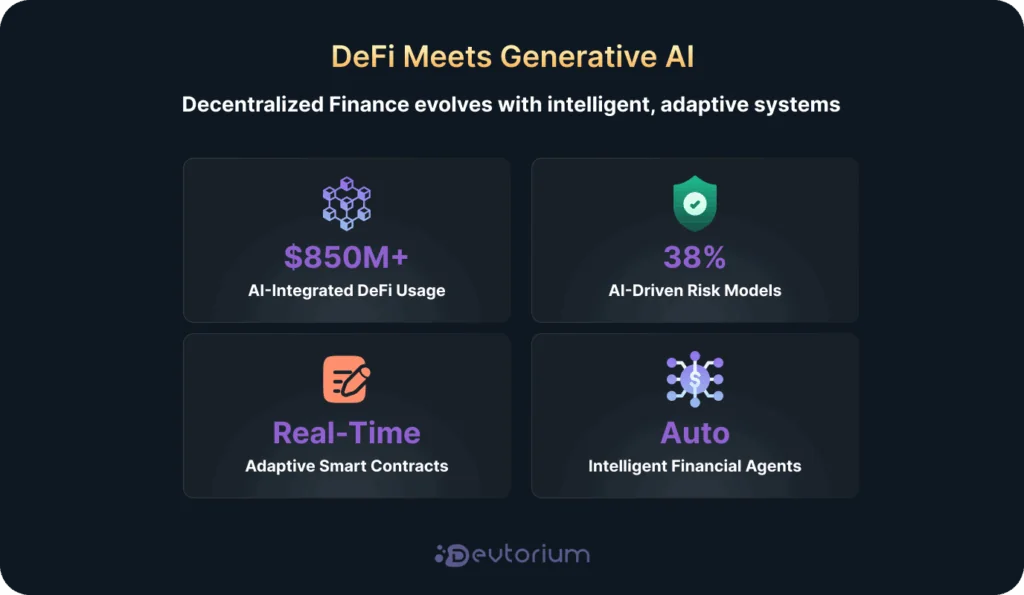
The numbers tell the story: AI-integrated DeFi protocols like Gauntlet AI and FetchFi have surpassed $850 million in combined usage, with AI-driven risk models now embedded in 38% of lending and insurance protocols.
Smart contracts don’t just execute predetermined rules; they can also learn and adapt. You’ve got AI models analyzing liquidity pools across dozens of platforms simultaneously, finding arbitrage opportunities in milliseconds, and optimizing yields in ways that would take human traders hours to calculate.
Generative AI is enabling:
- Autonomous financial agents that manage liquidity, optimize yields, and automatically identify the most profitable strategies.
- AI-audited smart contracts can self-check for vulnerabilities, adjust fee structures, and prevent malicious activity.
- Predictive DeFi dashboards that forecast token movements, identify early warning indicators, and deliver more profound insights into protocol health.
Here’s the practical part: DeFi has always been too complicated. Generative AI is changing that by explaining complex protocols in plain language, adjusted to whatever level of financial knowledge you’re starting with. AI in financial software development teams is now building intelligent agents that analyze smart contract code and warn you about potential risks before you connect your wallet.
AI-Powered Fraud Prevention and Cybersecurity in Digital Finance
Cybersecurity threats are evolving faster than ever. More than 50% of fraud now involves artificial intelligence, with criminals using deepfakes, synthetic identities, and coordinated bot attacks. The good news? Fintech software development teams are fighting back with even smarter AI.
90% of financial institutions now use AI to expedite fraud investigations and detect new tactics in real-time. The results speak for themselves: AI fraud detection systems have intercepted up to 92% of fraudulent activities before transaction approval.
Traditional fraud detection was a game of too little, too late. A suspicious transaction occurred, systems checked for known patterns, and it might have been flagged, often after the money had already moved. That approach is dead.
Modern AI doesn’t wait for fraud to happen; it anticipates it. By simulating thousands of potential attack scenarios, these models recognize early warning signs and neutralize threats before they touch a dollar.
Behavioral biometrics are leveling up, too. AI now observes how you interact with your banking app and not just passwords, but typing rhythm, scrolling habits, and even the time of day you check your balance. This builds a uniquely yours behavioral signature. Someone could steal your password, but replicating your micro-behaviors? Nearly impossible.
By 2026, generative AI-powered fraud prevention systems can:
- Instantly detect abnormal behavior, even when attackers mimic legitimate user patterns.
- Run synthetic attack simulations to uncover vulnerabilities in digital infrastructure.
- Perform real-time identity verification using biometrics, behavior analytics, and cross-channel data.
Cybersecurity is no longer just reactive – it’s predictive. AI software development deploys systems that continuously learn, adapt, and strengthen defenses without waiting for a crisis.
Revolutionizing Credit Scoring and Risk Management with Generative AI Models
Credit scoring has always had its blind spots. You can pay your rent on time for years, and still get rejected for a credit card because you lack “traditional credit history.” Meanwhile, someone who damaged their score five years ago is still paying for it today. Generative AI is finally fixing this mess.
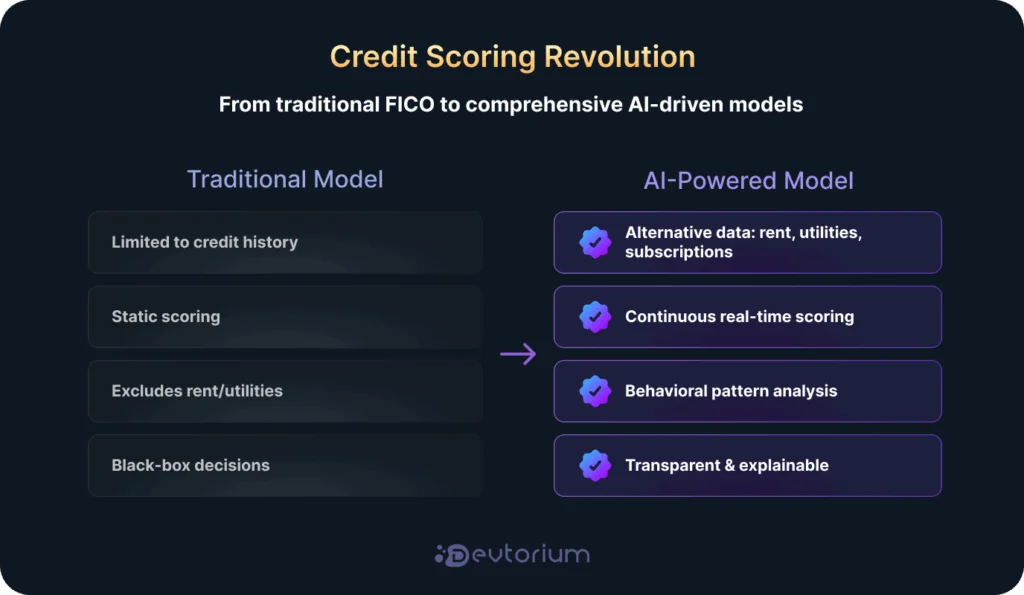
Credit scoring powered by AI software development goes far beyond the old FICO model. It considers rent and utility payments, subscription history, employment stability, and even education credentials. Someone with zero traditional credit history can now be evaluated more accurately than older models that evaluated people with thick credit files.
Lenders benefit too. Generative AI builds sophisticated risk models and stress-tests portfolios across thousands of economic scenarios. Risk pricing is evolving, too. AI continuously monitors market conditions and borrower behavior, adjusting rates in real-time, fairer for borrowers, safer for lenders, and fully compliant with regulations.
Regulators get a win here as well: explainability. AI doesn’t just deny a loan, it explains why a decision was made and, crucially, what an applicant can do to improve their chances. That transparency boosts compliance and helps people actually grow their financial situations.
Some key advancements reshaping credit scoring:
- Alternative credit modeling: pulling insights from behavioral patterns, transaction history, communication data, and more.
- Dynamic risk simulations: testing borrower stability across multiple economic scenarios.
- Continuous scoring: updating in real time as financial behavior evolves.
This isn’t just about smarter scoring; it’s about expanding access to financial services worldwide.
The Human Touch in an AI-Driven Financial World
Successful FinTech companies understand this: algorithms can automate routine tasks, but people still crave nuance, empathy, and personalized experiences. The best software development partners bring both cutting-edge tech and the insight to know when a conversation, not a machine, is needed.
AI in financial software development focuses on building “copilot” systems. The AI runs scenarios, highlights risks, and presents options. The human makes the final call, especially when the stakes are high or the decisions are ethically complex.
Customer experience is getting more personal, not less. Advice that once required a private wealth manager is now available to everyone, thanks to AI. The best systems feel human; they adapt communication style, explain concepts at your level, and know when to escalate to a human expert.
We’re seeing clear trends:
- AI-augmented financial advisors, helping experts provide richer, personalized guidance.
- Human-centered UX design, creating interfaces that feel intuitive and trustworthy.
- Transparent AI models give users insight into how financial decisions are made.
Financial literacy is evolving, too. Generative AI tutors answer questions, create personalized learning paths, and simulate scenarios so people can practice without real-world risk. As finance becomes more AI-driven, consumers become more empowered, not less.
What This Means for Your FinTech Business
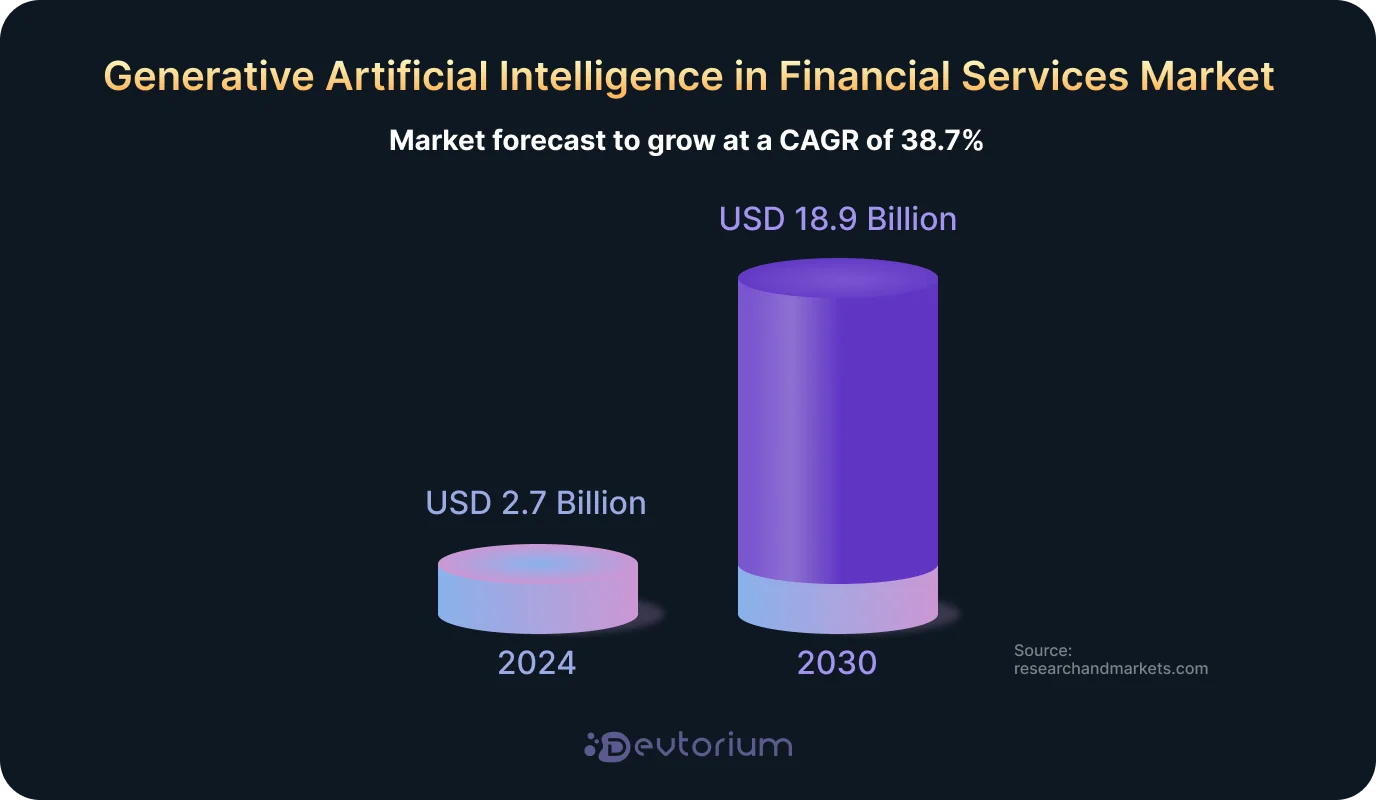
The market opportunity is massive. The global AI in fintech market was valued at $22.5 billion in 2023 and projected to reach $79.4 billion by 2030. But generative AI specifically? That’s exploding even faster – from $2.7 billion in 2024 to $18.9 billion by 2030, growing at 38.7% annually. Here’s the truth: “AI-first” isn’t a strategy anymore – it’s the minimum requirement.
The winners today invest in talent who understand both finance and AI, build infrastructure to handle heavy AI workloads, and foster cultures that encourage experimentation and treat failure as a learning opportunity. You don’t have to reinvent the wheel. The smart move is to partner with development teams that’ve already solved these challenges – teams who know financial regulations, have real AI experience, and can deliver solutions that work in production, not just demos.
Your competitive edge in 2026 isn’t simply having AI, it’s having AI done right. That means systems that are secure, explainable, and compliant; models trained on quality data and monitored for bias; and interfaces that make sophisticated AI accessible to end users.
The technical hurdles are real: integrating AI into legacy systems, protecting data privacy, managing model drift, and staying compliant with evolving regulations. These aren’t problems you want to learn on the fly in live production.
The combination of generative AI, decentralized infrastructure, and real-time analytics is pushing digital finance into a new chapter. Today, businesses need:
- Scalable systems ready to support intelligent automation.
- Flexible architectures that integrate advanced AI models.
- Experienced engineering partners who understand both financial complexity and the fast pace of AI evolution.
As a company specializing in FinTech software development, we help financial organizations navigate this transformation – building solutions that are secure, scalable, human-centered, and future-proof.
What’s Next: Winning in 2026
Generative AI is rewriting the rules of financial services faster than most realize. For consumers, financial services are becoming more accessible, personalized, and secure. For businesses, this brings both opportunity and urgency.
The opportunity: AI unlocks entirely new products and services that simply weren’t possible before. The warning: competitors are already leveraging this technology, and the longer you wait, the harder it becomes to catch up.
The future of money isn’t a distant possibility – it’s happening now. The real question isn’t whether to integrate AI into your FinTech software strategy; it’s whether you will lead the transformation or fall behind trying to follow it.
2026 marks a major transition in financial technology. Generative AI isn’t just enhancing existing systems – it’s redefining what FinTech can do.
Companies that embrace these shifts now will shape the industry’s next decade. Partnering with experts in AI software development and AI-driven financial solutions gives your business the agility, insight, and innovation needed to lead in this rapidly evolving market.
Ready to Transform Your FinTech Platform with AI? Our team specializes in AI-powered fintech software development that combines cutting-edge AI with bulletproof security and regulatory compliance.
Schedule a Free Consultation or Get in Touch to discuss how AI can transform your business.


