



Table of contents
What if an attack is already underway in your system, but remains undetected for months? That’s the reality many Companies face in 2025. Cloud infrastructure, containerization, distributed teams, and fast release cycles have introduced numerous new attack vectors. Together with the AppRecode team, we are examining why traditional security methods are becoming less effective – and what you need to do to ensure your security keeps up with your infrastructure’s rapid growth.
Why Traditional IT Security No Longer Works Like It Used To
Just ten years ago, many Companies relied on a basic set of tools:
- Antivirus software to protect endpoints
- Firewalls to filter external traffic
- Backup systems to restore data after failures or attacks
- Formal access policies for corporate resources
These methods were effective when most data was kept in on-premise data centers and teams worked from a single office connected to a secure corporate network.
But today’s IT landscape looks very different.
- Businesses are moving quickly to cloud and multi-cloud setups, with data spread across several providers.
- Applications rely on microservice architectures, running hundreds of containers with constant updates.
- The number of contractors and remote teams is increasing, connecting from various countries and networks.
- Employees use personal devices for work, which complicates security control and raises risks for the Company.
Each of these elements creates new threat vectors. The more systems and services you connect, the more chances attackers have to find a weak spot.
The more systems you connect, the greater the chance attackers have to find a weak spot. The main challenge is that threats evolve faster than traditional security measures can keep up. According to a 2024 Acsense study, organizations took an average of 204 days to detect a data breach, followed by an additional 73 days to contain and resolve it. That’s more than enough time for attackers to steal sensitive data, demand ransom, or damage a Company’s reputation.
Companies relying only on traditional IT security leave significant blind spots.
- Automated CI/CD pipelines frequently deploy code without thorough vulnerability scans.
- Cloud configurations change constantly, but access controls are updated manually and often fall behind.
- Event logs accumulate but aren’t reviewed in real time due to limited resources or a lack of analytics.
As a result, the Company faces silent attacks within its infrastructure, only discovering them too late, after data has been stolen, services are down, and confidential information has been exposed publicly.
That’s why modern cybersecurity is moving toward a proactive model, where protection is built into every stage of development and operations – the essence of DevSecOps. To stay ahead, Businesses need to act preventively. Here are three practical approaches to begin implementing today.
1. Embed DevSecOps into Every Stage of Development

According to the GitLab Global DevSecOps Report 2023, 56% of organizations are already practicing or adopting DevSecOps.
Let’s explore the core practices that DevSecOps teams follow.
- Early detection of code vulnerabilities. Automated scans run at every commit or pull request to catch potential issues during development, before they reach production.
- Control through Infrastructure as Code. IaC with built-in configuration auditing lowers the risk of mistakes when scaling cloud environments. According to Firefly, 90% of teams use IaC to enhance security, visibility, and management across multi-cloud environments.
- Flexible access management. Access is automatically granted or limited based on the user’s identity, device, and location. This approach follows the Zero Trust model and is enforced through tools like CIEM or CNAPP. It helps lower the risk of data leaks from compromised accounts or human mistakes.
2. Use AI to Detect and Neutralize Threats
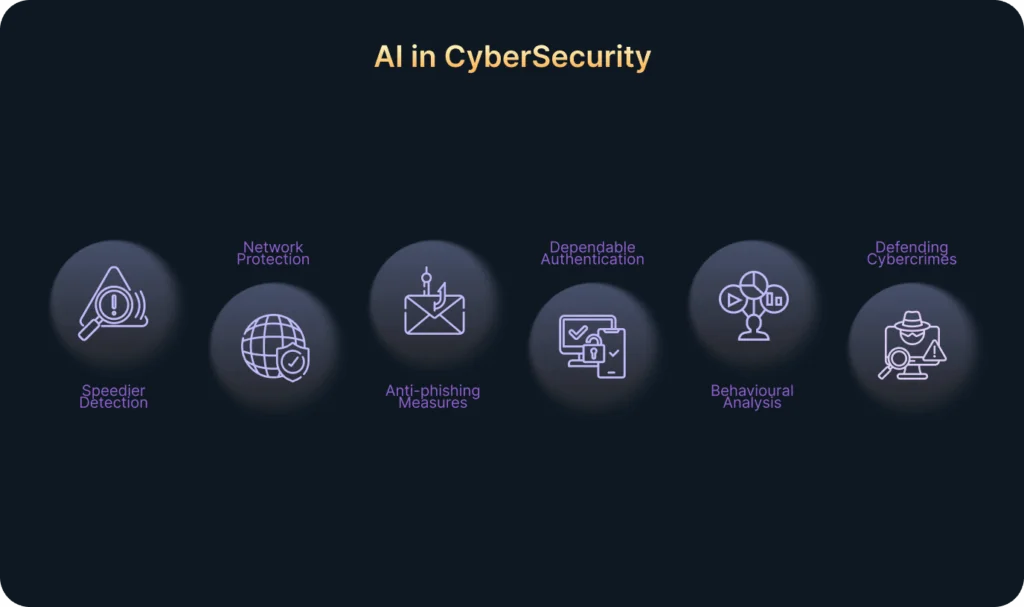
Another essential element of cybersecurity in 2025 is the use of AI-driven tools. They operate nonstop, processing vast amounts of data and events, far beyond what a person could handle manually.
Modern AI-powered security tools such as Splunk, Microsoft Sentinel, CrowdStrike, and IBM QRadar can:
- Analyze vast amounts of events as they happen, spotting suspicious logins, configuration changes, or unusual account activity.
- Detect behavioral anomalies in users and services that traditional rules often miss – for example, when an employee suddenly accesses sensitive data at odd hours or from an unexpected location.
- Forecast potential attack routes and identify recurring patterns in attacker behavior.
AI-powered SIEM systems (Security Information and Event Management) automatically correlate different incidents, merge scattered signals into a coherent overview, and filter out irrelevant or duplicate events that don’t need attention. Meanwhile, they notify analysts about the cases that require a response.
How AI Reduces the Load on Security Teams
AI is taking over routine but essential tasks that previously required large teams, including:
- Automatically applying patches to software and libraries
- Closing known vulnerabilities without delay
- Instantly blocking suspicious actions or access as soon as a threat is detected
- Generating ready-made response playbooks for quick incident resolution
This matters because the speed of response often determines whether an incident stays contained or escalates into a major crisis with significant losses and damaged trust from clients and partners.
How an Experienced DevOps Company and AI Can Enhance Your Data Protection
Pair an experienced DevOps team with modern AI, and your data shifts from reactive defense to always-on, predictive protection.
- Event monitoring and detection. SIEM and runtime tools (Splunk, Elastic SIEM with UBA, Datadog Watchdog, Falco) watch traffic, logs, containers, and user behavior to surface anomalies at once.
- Machine learning models. Cloud-native ML (Microsoft Sentinel, AWS GuardDuty) learns from historical patterns to flag novel attack paths and predict risky actions.
- Smart alerts. XDR/SOAR stacks (Palo Alto Cortex XDR, Cortex XSOAR) correlate signals so your team only sees alerts that warrant urgent action.
- Hands-off containment. Automated playbooks (e.g., Demisto, Splunk SOAR) can block accounts via EDR (e.g., CrowdStrike Falcon), apply patches (e.g., Snyk, Aqua Security), or restart services without requiring an operator’s intervention.
- Comprehensive coverage. Protection covers all layers, from the network to the cloud and CI/CD pipelines, using CNAPP platforms (Prisma Cloud, Wiz, Aqua Security) and CIEM tools for managing access.
- Operational excellence — A seasoned DevOps company unifies tooling, codifies runbooks and governance, tunes thresholds, and measures SLOs/MTTR so defenses stay effective as your systems evolve.
The result is a unified, adaptive security system that detects and stops threats before they cause harm.
3. Work with a DevOps Partner Who Integrates Security into Every Process
Protecting infrastructure in 2025 is a shared responsibility across Developers, Engineers, management, and the entire business. To achieve effective cybersecurity, Companies need a technical partner who has a firm grasp of automation, infrastructure, and security all at once.
Let’s explore four key areas where a DevOps partner can help build a modern security system:
- Identifying weak points. The partner will audit your infrastructure, pipelines, and access controls to find blind spots-places where security is missing or only superficially applied.
- Automating protection at every stage. DevOps specialists will configure CI/CD pipelines with built-in scanning for code and containers, implement Infrastructure as Code with controlled configurations, and ensure smooth delivery of updates without sacrificing security.
- Integrating AI solutions. AI tools help spot anomalies, forecast attacks, and automate threat response. DevOps engineers embed these tools into workflows to speed up reactions and reduce the burden on security teams.
- Implementing Zero Trust and flexible access policies. The partner will assist in deploying modern access strategies that grant users and services only the minimum permissions they need.
Summary
Cybersecurity in 2025 is an ongoing effort, not a one-time check. By embedding security throughout development and operations, you can defend your business against growing and rapidly evolving threats.
Move from reactive to predictive defense. Book a Devtorium consult to pinpoint blind spots, cut MTTD/MTTR, and embed security across every pipeline.


