



Table of contents
If you have bought anything online recently—and chances are you have—you’ve already experienced the impact of artificial intelligence. Maybe you searched for running shoes and suddenly the exact pair you were thinking about appeared in your Instagram feed. Maybe a website recommended the perfect fragrance or jacket without you even realizing how it knew your taste.
That invisible layer working behind the scenes is AI.
In 2026, artificial intelligence isn’t just a buzzword in eCommerce anymore. It has quietly become the engine powering how online stores are built, how customers discover products, and how businesses make decisions. From personalized recommendations to automated customer service, AI is transforming eCommerce development at a speed that would have sounded like science fiction just five years ago.
But what does this transformation actually look like in the real world?
Let’s break it down in practical, human terms.
The Old Way of Building eCommerce Platforms
To understand the shift, it helps to remember how online stores used to work.
Traditional eCommerce platforms were largely rule-based. Developers would build a website, upload product catalogs, create filters, and maybe install some plugins for analytics or marketing automation. Customer behavior was analyzed using basic metrics like:
- Page views
- Click-through rates
- Conversion rates
- Shopping cart abandonment
If a business wanted to improve results, teams had to manually analyze reports and run experiments.
For example:
A retailer might notice that many users abandon carts during checkout. The team would then redesign the checkout process and wait weeks to see if conversions improved.
This approach worked, but it was slow, reactive, and heavily dependent on human guesswork.
AI changes that completely.
AI Turns eCommerce from Reactive to Predictive
Think about walking into your favorite local store where the owner knows you personally.
They greet you and say something like:
“Hey, we just got a new jacket that matches the style you bought last month. Want to try it?”
That’s exactly what AI does for online stores—but at scale for millions of customers.
Instead of waiting for customers to browse randomly, AI systems analyze behavior patterns such as:
- browsing history
- purchase behavior
- search queries
- time spent on product pages
- demographic patterns
- device usage
Using this data, AI can predict what customers want before they even search for it.
According to industry research, AI-powered personalization can increase eCommerce revenue by 10–30% because customers are shown products they are more likely to buy.
Amazon famously attributes over 35% of its revenue to recommendation engines, which are powered by machine learning algorithms.
That is the power of predictive commerce.
Personalized Shopping Experiences
One of the most visible changes AI has brought to eCommerce is hyper-personalization.
Ten years ago, most websites showed the same homepage to every visitor.
Today, AI allows each user to see a completely different version of the store.
Imagine two customers visiting the same fashion website.
Customer A:
- frequently buys athletic wear
- browses gym equipment
- searches for protein supplements
Customer B:
- purchases dresses
- browses handbags
- searches for luxury brands
With AI, the homepage dynamically changes for each visitor.
Customer A might see:
- running shoes
- workout apparel
- fitness accessories
Customer B might see:
- designer dresses
- luxury handbags
- jewelry collections
It feels like the store was built specifically for them.
And that feeling dramatically increases engagement and conversion rates.
AI-Powered Customer Service
Customer support used to be one of the biggest operational costs for online retailers.
Every question required a human agent:
- Where is my order?
- Can I change my shipping address?
- Is this item available in another color?
Now AI chatbots and conversational assistants handle a large percentage of these interactions.
But unlike the robotic bots of the past, modern AI assistants understand natural language and context.
For example:
A customer might type:
“I ordered shoes yesterday but entered the wrong address.”
An AI system can instantly:
- Locate the order
- Verify the customer
- Update the shipping address
- Send confirmation
All within seconds.
This improves customer satisfaction while significantly reducing operational costs.
Many large eCommerce companies now report up to 70% of customer queries handled automatically by AI assistants.

Smarter Product Search
Search is one of the most critical parts of an eCommerce experience.
But traditional search engines relied on exact keyword matches.
If a customer typed:
“comfortable black office shoes”
Older systems might struggle if the product description didn’t contain those exact words.
AI-powered semantic search understands intent rather than just keywords.
Now the system interprets meaning.
It knows that:
- comfortable = cushioned or ergonomic
- office shoes = formal or business wear
The results become dramatically more accurate.
This reduces friction and helps customers find products faster.
AI in Pricing Strategy
Another major transformation happening behind the scenes is dynamic pricing.
Retailers used to update prices manually based on competitor research or seasonal promotions.
Now AI systems analyze multiple variables in real time, including:
- demand trends
- competitor pricing
- inventory levels
- seasonal buying patterns
- geographic purchasing behavior
Based on this data, the system automatically adjusts pricing to maximize profit and conversion.
Airlines have used this model for years. Now eCommerce is doing the same.
For example:
If a product suddenly becomes popular on social media, AI may slightly increase pricing due to demand.
If inventory is high and sales are slow, prices may drop automatically.
This allows businesses to remain competitive without constant manual intervention.
AI is Transforming eCommerce Development Itself
Perhaps the biggest revolution is happening in how eCommerce platforms are built.
Developers are now using AI-assisted tools to accelerate development.
Tasks that once took weeks can now be completed in hours.
Examples include:
- automatic UI design suggestions
- code generation
- performance optimization
- automated testing
- fraud detection systems
AI can even analyze user behavior and suggest improvements to website layout.
For instance:
If data shows users frequently abandon a page after scrolling halfway down, AI tools can recommend redesigning that section.
This turns development into an ongoing optimization process rather than a one-time launch.
AI and Fraud Prevention
As eCommerce grows, so does online fraud.
AI has become a powerful defense against fraudulent activity.
Machine learning models analyze patterns across millions of transactions to detect anomalies such as:
- unusual purchasing behavior
- suspicious IP locations
- mismatched billing information
- abnormal transaction velocity
If something looks suspicious, the system flags or blocks the transaction instantly.
This protects both customers and retailers.
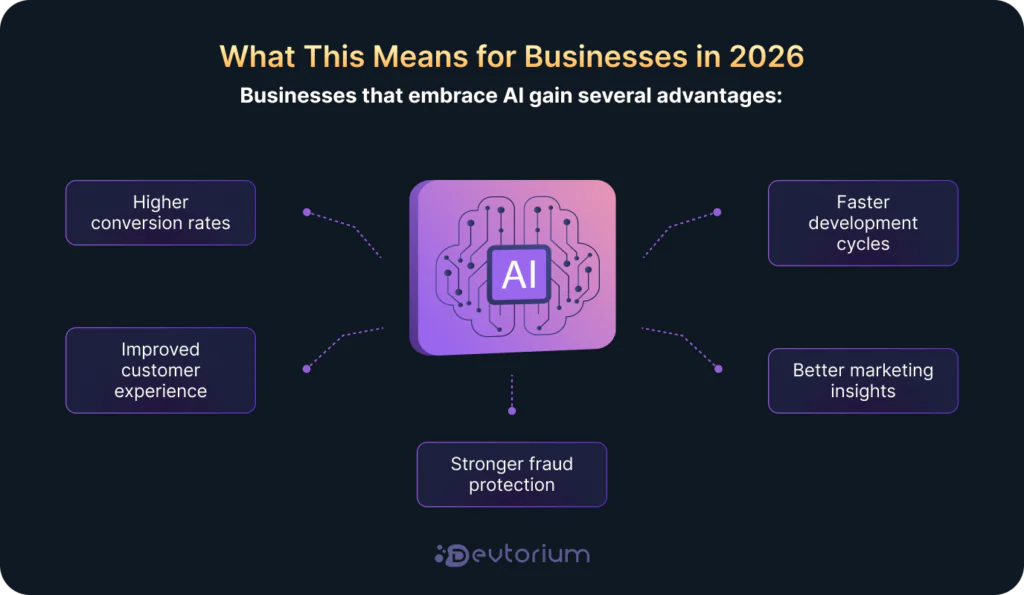
What This Means for Businesses in 2026
For companies building or upgrading eCommerce platforms today, AI is no longer optional.
It has become a fundamental part of digital commerce strategy.
Businesses that embrace AI gain several advantages:
- higher conversion rates
- improved customer experience
- faster development cycles
- better marketing insights
- stronger fraud protection
Companies that ignore AI risk falling behind competitors who can operate faster, smarter, and more efficiently.
The Human Side of AI in Commerce
Despite all the automation, the goal of AI is not to remove human connection from commerce.
In fact, it does the opposite.
AI helps recreate the personalized experience of a small neighborhood shop—but at global scale.
It allows businesses to understand customers better, serve them faster, and anticipate their needs.
In many ways, AI is bringing back something that modern commerce had lost: personal attention.
Only now, that attention is powered by data and intelligent systems.
Looking Ahead
As we move deeper into the decade, the role of AI in eCommerce will only expand.
We are already seeing early versions of:
- AI shopping assistants
- voice-powered commerce
- automated store creation
- predictive inventory management
- AI-generated product imagery
In the near future, building an eCommerce business may require fewer technical resources but more strategic thinking.
The companies that succeed will not just adopt AI tools—they will rethink how commerce itself works.
Final Thoughts
The evolution of eCommerce has always been driven by technology.
First came online stores.
Then mobile commerce.
Now we are entering the era of AI-driven commerce.
And just like previous technological shifts, the businesses that adapt early will shape the future of digital retail.
AI is not replacing eCommerce development.
It is redefining it.


