



Table of contents
Introduction: The Rise of AI Coding Assistants
When I reflect on how software development looked even five years ago, I’m struck by how radically things have shifted. In 2025 we’re no longer talking about speculative tools — we’re living with them. AI-powered coding assistants are now part of the daily toolbox for a growing number of developers.
In my own work (and in conversations with dozens of engineering leads over the past year), I’ve seen a pattern: these tools are not just “helpful extras”; they’re re-shaping the job itself. And for anyone leading a development organisation — whether in-house or in a service business — that means one thing: you must understand what’s changing, why it matters, and how you respond.
What an AI Coding Assistant Can Do Today

Put simply: the baseline of what an AI coding assistant can handle in 2025 is surprisingly broad — and that changes what we expect from human developers.
Natural language → working code:
You can now type something like: “Create a REST API in Node.js with JWT auth and paginated results, compatible with our existing /users endpoint” — and get a draft implementation that’s often 70-80% of the way there. This is no longer myth: recent academic work shows that generative AI tools for code co-creation reduce time on repetitive tasks by ~30-40% under certain conditions. arXiv+1
For instance, one study found for routine coding and test generation, the time savings are substantial — though as we’ll see, they’re not uniform.
Code-base navigation, summarisation & documentation:
Beyond writing code, these tools can now read your codebase, explain complex modules in plain English, generate API docs, produce unit tests automatically, and identify dead code or duplication. This kind of “assistant engineer” role is increasingly common. For example, research into contextualised assistants found developers report marked time-savings in understanding internal APIs. arXiv
Debugging and refactoring:
When a stack trace lands at your desk with only two hours until the release branch, AI assistants are now capable of suggesting likely causes and proposed fixes — in many cases multiple variants — speeding up the “guess and fix” loop. Some real-world delivery organisations report 20% productivity uplift when these tools are integrated properly. New York Post
Agentic, multi-step workflows (on the horizon):
We’re also starting to see what I call “assistant + agent” tools: not just autocomplete but multi-step workflows (e.g., “create a feature flag, wire it across config, add UI toggle, generate tests, update docs”). Early controlled studies suggest these agentic assistants can exceed copilots in usefulness—but also introduce new challenges. arXiv
In sum: the baseline is shifting. The question is no longer “can AI help?” but “how will we adapt when it does?”
Impact on Developer Roles & Skills — What’s Changing?
If you lead engineering or software services (or you’re a developer yourself looking ahead), the shifts may feel subtle day-to-day — but the implications are profound.
From writing code to orchestrating code generation:
If your team is relying heavily on assistants to write boilerplate, scaffolding, tests, etc., the human developer’s value shifts to higher-order roles: specifying architecture, reviewing and refining AI output, managing edge cases, ensuring security, and integrating modules meaningfully. One recent MIT Sloan article observed that generative AI tools increase productivity, especially among less-experienced developers — but the greatest value comes when you combine domain knowledge + tool fluency. MIT Sloan
In my own conversations with senior engineers, the refrain is: “I spend fewer hours typing code, more hours reviewing what the assistant generated.”
Prompting becomes a real skill — but it’s not just prompting:
Yes, you’ll hear a lot about “prompt engineering” — and it is becoming part of the engineering craft. But the underlying skills remain: domain understanding, system design, code review discipline, and the ability to spot when the assistant is wrong. The best prompts are clear, constrained, grounded in the codebase, and iterated on — so developers need to think, “What does the assistant not know?”
One academic paper noted that while GenAI tools can enhance productivity for routine tasks, they struggle with “complex, domain-specific activities” because of context-limitations and design-rule mismatches. arXiv
Code review, governance & security rise sharply:
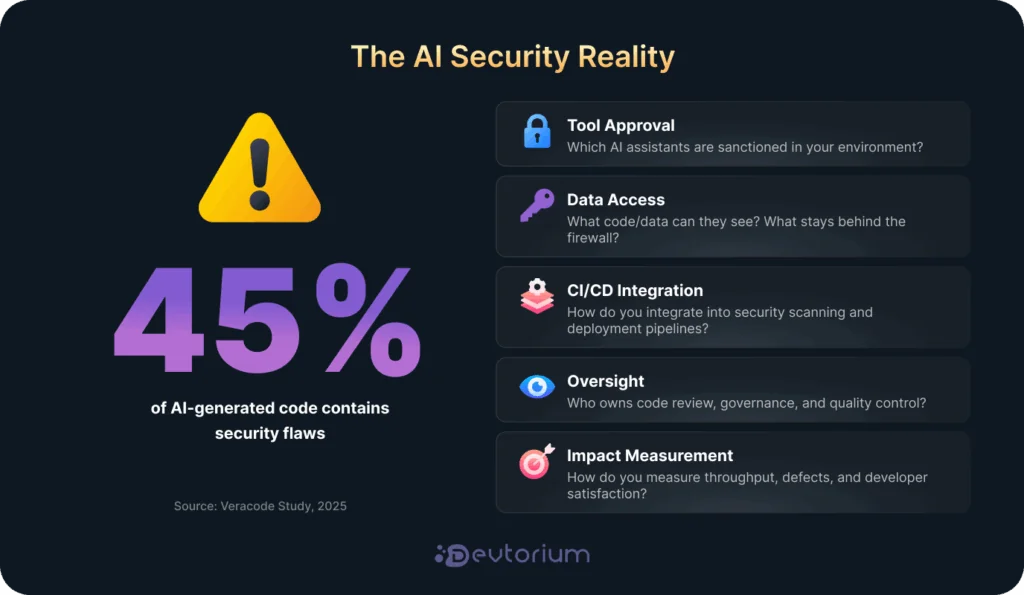
Here’s a practical bit you’ll hear in boardrooms: if your team adopts AI assistants, you are introducing new risk vectors. A study by Veracode (Aug 2025) found nearly 45% of AI-generated code contained security flaws—even in large LLMs and mainstream languages. TechRadar
That means senior engineers will increasingly find their job defined by governance: Which assistants are sanctioned? What data do they access? How do you review their output? How do you integrate them into your CI/CD, security scanning, license-compliance workflows?
In short, governance matters as much as productivity gain.
Junior vs senior dynamics change:
One of the most interesting (and uncomfortable) shifts: many of the entry-level, “coding-in the trenches” tasks are now being assisted, accelerated, or in some cases re-assigned. A notable controlled study found that in some open-source developer settings, using AI tools increased completion time by 19% — surprising, but reflective of complexity in adoption. arXiv+1
What this suggests: the hierarchy may flatten. Organizations may prefer fewer, more senior engineers working alongside AI rather than larger junior-heavy teams. For a junior dev entering 2025, the expectation isn’t just “write code”, it’s “work effectively with AI, review AI, contribute value beyond typing.”
If you’re a service provider, you’ll need to rethink your staffing and training models accordingly.
Productivity Gains vs. Job Displacement: Myths and Facts
So amid all the bold claims and looming anxieties, what’s really true?
Myth #1: AI assistants make all developers drastically faster, across the board.
Fact: The gains are real — but uneven. For example:
- Some studies show time reductions of ~30-40% for repetitive coding or test tasks. arXiv+1
- Yet the METR study found increased task completion time (+19%) in some settings when AI was used. Reuters+1
- One industry blog found only 16.3% of developers said AI made them “much more productive,” while 41.4% said little or no effect. Cerbos
In short: If your tooling, codebase, processes, and review practices aren’t aligned, the potential gains shrink.
Myth #2: All developers benefit equally from AI.
Fact: Not true. The benefit curve depends on experience, task type, and environment. For example, the MIT Sloan research found less-experienced engineers had higher adoption and greater productivity uplift in some cases. MIT Sloan
But paradoxically, a later finding shows more experienced developers are also more likely to accept agent-generated code effectively — reflecting trust, domain familiarity, and context-understanding advantages. AI Insider
Therefore: The real winners are the engineers who combine domain strength + tool fluency + selective use of AI.
Myth #3: AI assistants will replace all developers.’
Fact: Broadly speaking, no — but the shape of demand is changing.
- We’re seeing pressure on routine tasks (CRUD APIs, simple scripts, refactors) where AI tools excel.
- At the same time, organizations adopting AI well often expand what they can build — meaning more features, more innovation, which in turn drives demand for senior talent.
- For service firms: your pricing model, team model, and delivery model need adjustment. If your solution used to be “large team, many hours,” you may need to shift to “leaner team + AI accelerator + higher value delivery.”
So the takeaway: AI reshapes developer jobs more than eliminates them — but you need to be proactive.
How Service Providers and In-House Teams Should Respond
If you’re running a software services firm, or managing an in-house dev team, here are action-oriented moves I recommend this year.
1. Define a clear AI tool-use strategy (don’t just experiment).
It’s tempting to give everyone access to Copilot or ChatGPT in the IDE and call it a win. But I’ve seen far too many organisations do that — then blame “AI didn’t deliver.”
Ask these questions:
- Which assistants are approved in your environment (cloud vs on-prem)?
- What code/data can they see? What must stay behind the firewall?
- How will you measure impact? (throughput, defects, cycle time, dev satisfaction)
- Who owns oversight, review, governance?
If you already provide AI-driven software development as a service, you’ll want to weave this messaging into your client engagements: “we don’t just use AI, we manage it responsibly, integrate it from backlog to release.”
2. Re-design your delivery process around AI augmentation.
Best results come when AI is embedded across the lifecycle: discovery, design, implementation, testing, deployment, maintenance.
- In discovery: use AI to draft user-stories, feature specs, initial architecture sketches.
- In implementation: scaffold code, tests, documentation with AI, then have humans focus on logic, performance, integration.
- In QA/maintenance: use AI for test-case generation, bug-triage summarisation, even post-mortems.
When you do this, you unlock more value than just faster typing. As one McKinsey report put it: the real benefit of AI in software development comes when the tool is deeply integrated into the entire product lifecycle. faros.ai
3. Upskill people in “AI literacy”, not just “tool training”.
This is not about running a 1-hour workshop on Copilot. It’s about shifting mindsets. Developers must learn:
- How to frame prompts effectively, understand assistant limitations, iterate on output.
- How to review AI-generated code critically (security, licence issues, architecture fit).
- How to think at system-level rather than line-by-line typing.
In the staffing market, candidates who can say “I’ve used AI assistants effectively and understand how to integrate them” will have a competitive advantage.
4. Re-think your team composition and pricing models.
For service providers: if your model assumes many junior devs grinding code, you may need to shift. Consider:
- Smaller, senior-led teams using AI to amplify throughput.
- Pricing tied to outcomes (features delivered, time-to-market) rather than hours billed.
- Specialized “AI augmented delivery” packages where you highlight the speed and quality gains.
In-house teams can similarly benefit: leaner teams empowered by AI may deliver more — allowing orgs to shift resources to innovation rather than just maintenance.
5. Create differentiated offerings around AI — not just use it internally.
If your organisation offers software services, make your AI-enabled delivery a feature for your clients. For example:
- “We deliver a rapid MVP with AI tools” — highlighting speed, documentation, test-coverage, and cost-efficiency.
- “We integrate AI-powered code review and refactoring” — reducing technical debt for the client.
- Offer transparent AI governance: show clients how you manage model risks, data security, and code quality.
Making AI a core part of your value proposition rather than a hidden ‘secret sauce’ creates trust and differentiation.
Conclusion: Preparing for the Future of Development Work
If you lead in software services or manage a development org, here’s what I want you to take away: This isn’t some distant possibility. The rules of the game are already different in 2025.
Your job — and your team’s job — is shifting from “write more code” to “design and govern smarter systems”. Your competitive advantage will come from how well you pair human expertise with machine assistance.
The good news? For organisations that embrace this shift, the opportunity is large: faster time to market, better documentation/test coverage, lower maintenance overhead, and more innovative outcomes.
The risk? Falling behind — using AI as a half-baked tool and losing the gains. Or worse, hiring in a model that no longer fits the market.
Here at Devtorium, where we specialise in AI-driven software development, we’ve already begun helping clients shift their mindsets, toolchains and delivery models. And we’ve seen how small changes deliver outsized results.
If you’re ready to lead the change — not just respond to it — the time is now.


