


Table of contents
Quantum computing fintech security is becoming one of the most critical concerns for the industry. The protection of any fintech solution is directly tied to the “breakage difficulty,” or, more formally, the computational intractability of the algorithm used to encrypt it.
At present, several widely adopted algorithms require far more time and computational resources to break than the most powerful modern computers can provide. Among the most prominent are RSA and Elliptic Curve Cryptography (ECC), both based on mathematical problems that lack fast or efficient solutions.
However, nothing lasts forever. The rise of quantum computing is emerging as a defining fintech security challenge of our time. According to leading cybersecurity and engineering experts, a tipping point is approaching at which today’s strongest encryption could be compromised within hours. This moment is commonly referred to as Q-Day — the point at which advanced quantum computers will be capable of doing this.
In the first part of the blog, Devtorium cybersecurity experts will try to answer these questions: what is quantum computing, what risks does it pose, and why now?
Quantum Computing & FinTech Security: Are RSA and ECC Still Resilient Enough?
It has been nearly five decades since the publication of the research behind RSA, and over forty years since the concept of Elliptic Curve Cryptography (ECC) was introduced in cryptography. To this day, both algorithms are considered secure against attacks performed by classical computers. However, the question remains: will they stay reliable for another 40 or 50 years? To understand the risk and why the algorithms that protect financial systems today may no longer hold, it would be beneficial to examine them more closely.
RSA is an asymmetric cryptographic algorithm, meaning it relies on a pair of different keys: a public key and a private key. In simple terms, anyone can use the public key to encrypt a message, but only the recipient, who possesses the private key, can decrypt it. Asymmetric cryptography is designed such that decrypting a message without the private key is practically impossible. In the case of RSA, recovering the private key would require factoring a very large number (e.g., a 2048-bit modulus) into its prime components. This problem is considered computationally intractable, as it requires prohibitive time and processing resources to solve.
Today, RSA is widely used not only for securing internet communications (SSL/TLS), but also across private and government banking systems to protect digital signatures, transactions, files, credit card information, and other sensitive financial data.
Elliptic Curve Cryptography (ECC) is also an asymmetric encryption method, but it is based on the algebraic properties of elliptic curves and the Elliptic Curve Discrete Logarithm Problem (ECDLP). In essence, a point on a predefined elliptic curve is repeatedly “multiplied” (more precisely, added to itself following specific mathematical rules). It is easy to calculate the final result, but extremely difficult to reverse the process (to determine how many times the point was added), which is considered infeasible without access to the private key.
ECC is widely adopted in modern security protocols (including SSL/TLS), mobile applications, cryptocurrencies, and financial systems.
But will these algorithms remain reliable? Despite their current strength, RSA and ECC are not future-proof. Experts predict that with the rise of powerful quantum computers (possibly as early as 2030), these algorithms could become vulnerable. So, if your system’s security relies solely on these types of encryption, it is worth reconsidering your approach and taking action now. Threat actors are already preparing for the era of quantum computing.
What Are Quantum Computing & Q-Day?
Understanding quantum computing fintech security risks starts with understanding what quantum computers actually are and how they differ from classical machines.
At the beginning of the 21st century, it seemed that classical computing had reached its computational limits. However, a wide range of math problems remain unsolved with current architectures (incl. the cryptographic algorithm mentioned earlier).
As early as the 1980s, researchers introduced the concept of a fundamentally new computing device based on the principles of Quantum Mechanics. This approach led to the development of the Quantum Computer. So, how does it actually work?
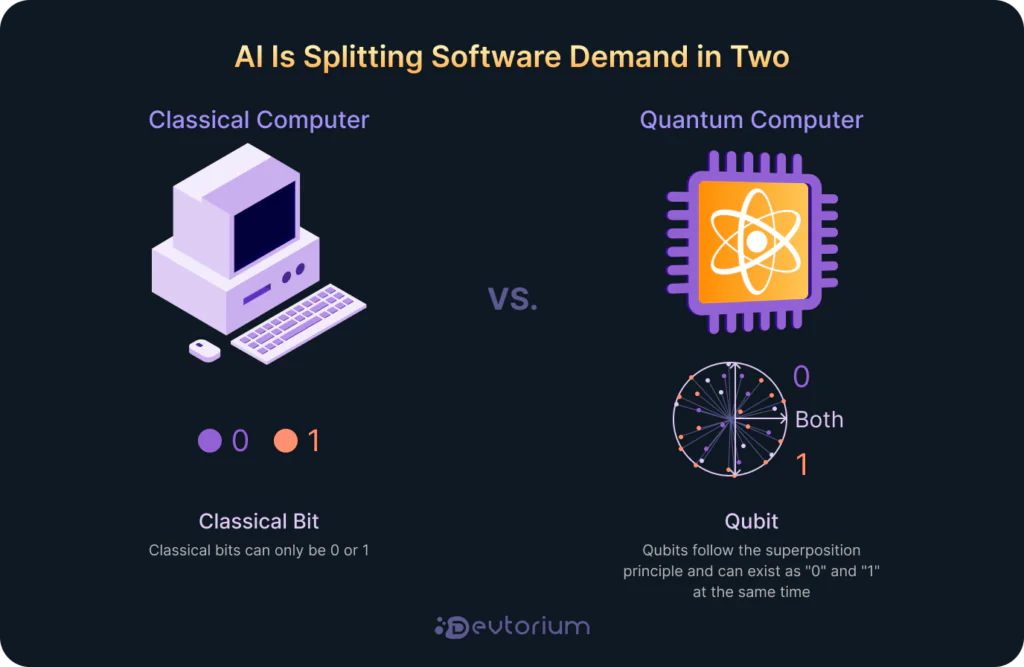
Classical computers process information by encoding it in binary form, using bits (the fundamental units of data) that can exist in one of two states: 0 or 1. In other words, modern computing logic operates within a strictly deterministic framework limited to “yes” or “no” states.
In contrast, quantum computers rely on the principle of Superposition. Instead of bits, they use qubits (quantum bits). Through quantum logic operations, qubits can be placed into a superposition state, meaning they can exist as both 0 and 1 simultaneously. This property enables quantum computers to perform massively parallel computations and to solve complex problems significantly faster.
At present, quantum computing is moving from experimental prototypes to early-stage practical applications, much as AI did in the 2010s. The primary changes focus on increasing qubit counts and improving their stability through error correction.
According to researchers, breakthroughs in superconducting circuits in late 2025 suggest that quantum algorithms (such as Shor’s) may be executable very soon. This would enable the solution of certain computationally hard problems at an exponential speedup, effectively compromising both RSA and ECC.
The day when a quantum computer can efficiently break asymmetric encryption protocols that secure most global digital financial transactions is referred to as Q-Day. The issue is that this is no longer an “if” scenario, but a very real “when” threat. In other words, Q-Day is approaching and requires immediate attention. Threat actors are already adapting their strategies. Specifically, they are collecting leaked or intercepted encrypted financial data with the intent of decrypting it once quantum capabilities become available. This approach is known as SNDL (Store Now, Decrypt Later).
Conclusion: Risks & Challenges for Financial Organizations
Quantum disruption introduces a new class of quantum computing fintech security risks that financial businesses cannot overlook. The primary concern is not only future attacks, but the current exposure of sensitive data that may be decrypted later. Key risks include:
- Data longevity risk (financial records must remain secure for decades)
- “Store now, decrypt later” attacks
- Regulatory uncertainty and upcoming compliance requirements
- Complex migration from RSA/ECC-based systems
- Legacy infrastructure limitations
- Performance and integration trade-offs with new cryptographic standards
Delaying action increases both technical debt and strategic risk.
However, if you want to assess your readiness and implement an effective security solution, contact us to schedule a free consultation with Devtorium cybersecurity experts.


