



Table of contents
Sustainable eCommerce growth requires a strong personalization framework. This statement is true across every sector, including wellness. Integrating effective personalization directly into your sales platform drives long-term business scalability and performance.
Consider the impact personalization can deliver:
- marketing teams gain data-driven insights into which wellness products and services to promote;
- sales teams can build accurate customer personas and target real pain points more effectively;
- business and product analysts can evaluate the solution portfolio with greater precision and identify optimization opportunities;
- customer support teams benefit from automated prioritization, allowing them to focus on priority tasks.
And this list goes on.
In this blog post, our developers share effective personalization approaches for wellness eCommerce, real case studies, and a practical way to measure ROI.
Personalization Strategies in Wellness eCommerce Software
Let’s start by defining personalization. From the user’s perspective, it is the moment when an app or website feels like it “gets them”. But to achieve this feeling of smart recommendations, it is better to understand personalization from the developer’s perspective.
Personalization is the systematic design and implementation of software capabilities that adapt to each user’s attributes, behaviors, context, and goals. In practice, it means you do not build static feature sets or some UI tricks. Instead, your development team architects a system capable of ingesting user-specific data, modeling their intent, adapting functionality, and continuously optimizing to improve personalization algorithms over time, a core capability delivered through modern eCommerce development services.
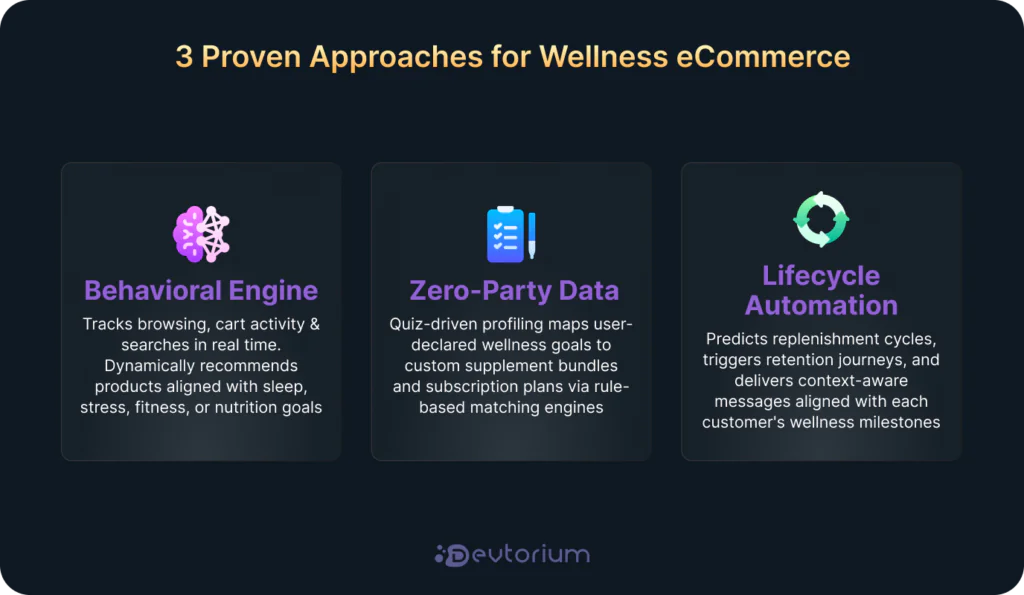
Effective implementation of the personalization module requires a predefined strategy or a combination of approaches. Proven personalization strategies include:
Behavioral Personalization Engine
A behavioral personalization engine operates on real-time interaction data. It tracks browsing patterns, product views, cart actions, and search queries to infer user intent. Based on this behavioral model, the platform dynamically recommends products aligned with each customer’s specific goals (e.g., sleep enhancement, weight management, stress reduction, or muscle gain). It can also prioritize relevant categories and apply behavioral nudging to encourage habit formation (e.g., daily supplement routines).
From a development perspective, this requires a well-structured data layer: a Customer Data Platform (CDP) or a unified user profile; an event-tracking architecture; real-time recommendation algorithms; and a rules-based or ML-driven decision engine integrated into the platform.
Zero-Party Data Personalization
Zero-party data personalization relies on information users explicitly provide. In wellness eCommerce, this typically involves structured data collection through quizzes (skin type, dietary preferences, stress levels, fitness goals). The platform then maps responses to predefined logic algorithms to generate tailored product suggestions.
Development features include configurable quiz builders, data validation layers, rule-based matching engines, and algorithms for generating custom supplement packs. The system may also create personalized subscription bundles based on declared health objectives and usage frequency. This strategy requires secure data storage and clear governance for privacy and compliance (GDPR and HIPAA, when applicable).
Lifecycle Automation Personalization
Lifecycle automation personalization focuses on customer retention and long-term value. It predicts replenishment cycles based on product type, dosage, and purchase history, triggering timely reminders before supply depletion. Context-aware recommendations may adjust based on time of day, seasonality, or behavioral signals.
Core development components include purchase history analytics, consumption-cycle algorithms, automation workflows, and event-trigger engines for email/SMS journeys linked to wellness milestones. Full effectiveness requires integration with CRM systems, marketing automation platforms, and subscription management modules to synchronize messaging, retention campaigns, and customer lifecycle data.
How to Measure ROI of Personalization?
Building personalization features is only part of the equation. The real question is whether they deliver measurable value. Measuring ROI requires isolating the incremental financial impact directly attributable to personalization capabilities. The core formula is straightforward:
ROI = (Incremental Revenue – Personalization Costs) / Personalization Costs.
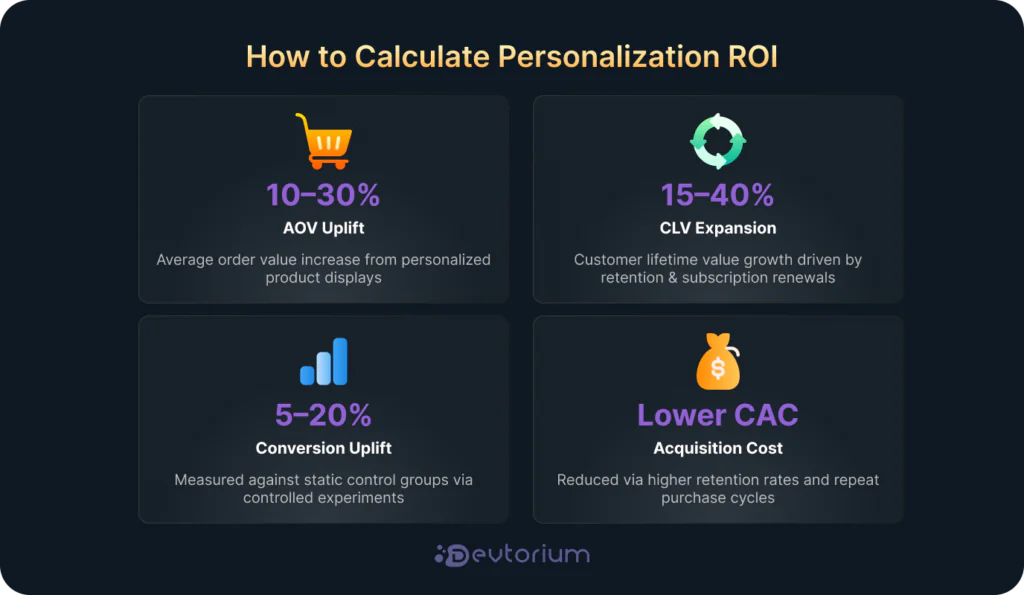
Incremental revenue should be calculated through controlled A/B testing, comparing personalized experiences to static ones. Key performance indicators include conversion rate uplift, average order value (AOV), revenue per visitor (RPV), repeat purchase rate, and Customer Lifetime Value (CLV). In the Wellness eCommerce space, retention metrics are particularly critical given subscription models and replenishment cycles.
Beyond revenue growth, operational efficiency should also be measured by metrics such as reduced cart abandonment, improved subscription renewal rates, and lower customer acquisition cost (CAC) resulting from higher retention.
On the cost side, include development hours, infrastructure (CDP, ML models), integration expenses, and ongoing optimization resources.
When personalization produces measurable gains in AOV (10-30%), conversion uplift (5-20%), and CLV expansion (15-40%), the financial justification becomes evident. Data must validate your personalization strategy, not intuition or advertising claims.
To maximize the impact of your personalization strategy, start by assessing your current approach, running A/B tests, and leveraging the benchmarks provided. Let data drive scalable growth in wellness eCommerce. Start measuring your ROI from personalization today.
Case Scenarios of Personalization in Wellness eCommerce
Practical examples of personalization in wellness eCommerce demonstrate how tailored experiences directly translate into improved business outcomes.
For example, in Devtorium’s superfood and supplements online store, enhanced data analytics and automation were implemented to tailor promotional content and product displays based on customer behavior and past purchases. This led to higher engagement with targeted product suggestions, effectively increasing conversion and repeat purchases.
Another strong example comes from a custom web app for caregivers, where rich questionnaire-based profiling allowed the system to personalize matches between needs and support resources – an analogous personalization principle applicable to wellness (e.g., matching users to tailored health plans).
In the molecular dietary supplements online store, bundling logic was introduced alongside segmented marketing based on membership tiers and purchase history. Customers saw curated bundles and offers aligned with their preferences, driving larger cart sizes and stronger loyalty.
And while not an eCommerce platform per se, complex wellness appointment-booking software integrated loyalty and messaging automation to serve personalized confirmations and follow-ups, increasing retention and engagement.
These cases illustrate that personalization, whether through behavior-driven analytics, membership segmentation, questionnaire-based matching, or tailored messaging, drives engagement and retention, which in turn increases revenue.
Conclusion: Personalization as a Measurable Growth Engine
Wellness brands that treat personalization as core infrastructure will define the next stage of digital commerce. The shift is clear: a well-architected personalization framework enables measurable gains in conversion, AOV, and CLV while simultaneously improving operational efficiency. However, the real competitive advantage lies in execution.
Ready to Turn Personalization into Measurable ROI?
Our team designs and delivers eCommerce development services with embedded personalization engines, predictive analytics, and AI-driven automation. Schedule a free consultation to discuss how we can architect a personalization strategy that delivers measurable growth for your wellness business.


