


Table of contents
AI is, without a doubt, a revolutionary technology. The fields and spheres of its application seem to be limitless. Even small businesses and startups can highly benefit from using it. According to the Springs, in 2025, 50% of digital work is estimated to be automated through apps using AI. So, you’ll only need to choose the best fit for your organization. However, that is where the main obstacle comes: which AI tool to select.
Today, the market provides a variety of large language models (LLMs). Each of them has different tools and outcomes. Moreover, they even have different capabilities and possibilities. For coding, it is better to use one LLM, while for more general requests, you should use another one. As a result, anyone could get confused when choosing the right AI for their purpose. That is why Devtorium R&D experts prepared this informative blog about the most effective LLMs today. After reading, you will better understand which one would be suitable for your AI software development services.
ChatGPT
ChatGPT stands for “Chat Generative Pretrained Transformer.” This LLM was developed by OpenAI. There are three available models: GPT-4o, GPT-5, and GPT-5 Pro.
Chat GPT-4o is a free version model that anyone can access. It supports multimodal input (text, images, audio, and video) and processes tasks much faster than older GPT-4 models. However, it still has limitations in complex reasoning tasks compared to the newest models.
Chat GPT-5 is available with a $20/month subscription. It was designed for professional and business use. The model offers significantly improved contextual understanding and advanced reasoning in long-form content. Among its drawbacks is that it consumes more compute resources, so in some cases it may respond slightly slower than the cost-optimized versions.
Chat GPT-5 Pro (or GPT-5 with extended context) is the latest enhanced version that combines GPT-5’s reasoning capabilities with faster performance and longer memory. It has both free-tier limited access and paid plans with priority processing. Inputs can include text, images, audio, and video. Even though GPT-5 Pro is optimized for speed, its context retention and reasoning remain close to the GPT-5 model.
ChatGPT’s Use Cases:
- Cost-Effective Solutions. For budget-conscious projects, models like ChatGPT-4o (and its optimized successors such as GPT-4.1-mini) offer a balance between performance and affordability.
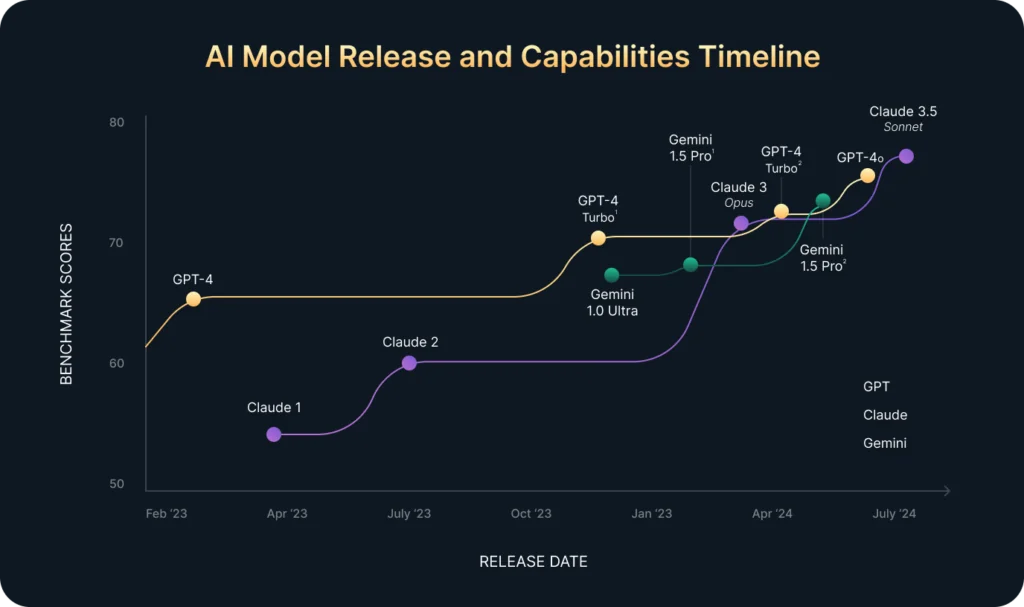
- Hard Prompts. Advanced versions like GPT-5 are highly effective for nuanced responses. According to the latest LM Arena Leaderboard (the largest crowdsourced benchmarking platform comparing 300+ AI models), GPT-5 and GPT-4o consistently rank at the top in human-evaluated reasoning performance, outperforming both open-source and commercial models.
- Longer Queries. ChatGPT-5 excels at understanding context and coherence across extended conversations, making it ideal for research, multi-step tasks, or strategy development.
- Versatile Applications. From creative writing to code generation to even multimodal tasks (text, images, audio, video), ChatGPT has developed each of its available functions equally.
Claude
Claude is a family of AI language models developed by Anthropic. These LLMs focus on providing safe AI interactions. Among its models available at the moment, there are Claude 4 Sonnet, Claude Sonnet 4.5, Claude 4 Opus, and Claude Opus 4.1.
Claude 4 Sonnet is efficient for everyday use with strong performance across a wide range of tasks. It offers a balance of speed and capability, so that it is suitable for generic chatbots and content generation.
Claude 4 Opus and Claude Opus 4.1 are the most capable models in the Claude 4 family. These models excel at complex tasks requiring deep contextual understanding and nuanced outputs, offering enhanced creative capabilities.
Claude Sonnet 4.5 is the smartest model in the Claude 4 family. It represents the most advanced iteration currently available and outperforms previous versions across various benchmarks. Like other top-tier models, it may have slower response times due to more complex processing for more accurate output. Claude Sonnet 4.5 features advanced capabilities, including sophisticated tool use, allowing it to interact with external functions and APIs, perform web searches, and create complex artifacts. It is accessible on Claude.ai, with subscribers to the Claude Pro and Team plans.
Claude’s Use Cases:
- Code generation. Claude Sonnet 4.5 achieves outstanding performance on coding benchmarks, including a 77.2% score on SWE-bench Verified AnthropicInfoQ. It demonstrates the exceptional capability of this model to generate optimal code across 20+ languages. Additionally, the model can run continuously for over 30 hours on complex software development projects.
- Vision analysis. Claude Sonnet 4.5 demonstrates strong computer use capabilities, including analyzing images, documents, and PDFs, and extracting key information for diverse tasks. It is available with basic features on free plans, while paid plans offer enhanced capabilities and higher usage limits.
- Ethical AI Applications. Every Anthropic model is built on nuanced AI principles that prioritize safety. Claude Sonnet 4.5 achieved a 98.7% safety score on malicious code requests. All responses Claude provides must adhere to these principles. Claude is forthright about its limitations and potential biases, promoting responsible AI use.
- Complex Decision-Making. Claude was designed to handle intricate scenarios with multiple variables. Moreover, it is ideal for tasks that require deep contextual awareness.
If you are looking for a provider of AI software development services, contact us and get a free consultation.
Meta LLaMA
LLaMA (Large Language Model Meta AI) is an open-source LLM developed by Meta (formerly Facebook). The main feature of this model is its low resource intensity, enabling researchers and developers to run advanced AI on smaller hardware. At the moment, Meta offers these LLaMA models: LLaMA 2, LLaMA 3, LLaMA 3.1, and the newest experimental branch, LLaMA 4 (Scout / Maverick).
LLaMA 2 is a free-to-use open-source AI model. It is the first openly available LLM instruction-tuned for text. LLaMA 2 is still a lightweight solution suitable for commercial use if you struggle with huge budgets. However, this model is outdated, so that you can find inexpensive alternatives providing higher performance.
LLaMA 3 is the next generation of LLama, significantly upgraded. This model introduced strong multilingual support and has better prompt understanding. However, its reasoning and mathematical accuracy are average compared to more recent releases.
LLaMA 3.1 is an improved continuation of LLaMA 3. It delivers better reasoning and coding capabilities, supports long context, and became the largest openly available model on the market at the time of release. If you are looking for the most capable free-to-use open-source LLM, this version remains a top choice.
LLaMA 4 (Scout / Maverick) is the newest experimental generation based on LLaMA 3.1 improvements. It focuses on reasoning-first capabilities and introduces two configurations:
- Maverick – optimized for higher reasoning accuracy and long-context responses
- Scout – optimized for fast inference and agent-like autonomy
LLaMA’s Use Cases:
- Commercial-free. This AI model is ideal for many business applications without additional costs.
- Meta Integration. LLaMA can be easily integrated into Meta AI, Facebook, Instagram, and WhatsApp, providing advanced AI capabilities for content generation, customer interaction, and personalized user experiences.
- Multimodal Tasks. The model offers robust support for diverse languages and media formats, making it a versatile tool for global and cross-platform applications.
Gemini
Gemini is an AI model developed by Google DeepMind. It is positioning itself as a competitor to the present advanced LLMs like GPT-5. There are multiple Gemini models on the market: Gemini 2.0 Flash, Gemini 2.0 Flash-Lite, Gemini 2.0 Pro, Gemini 2.5 Flash, and Gemini 2.5 Pro
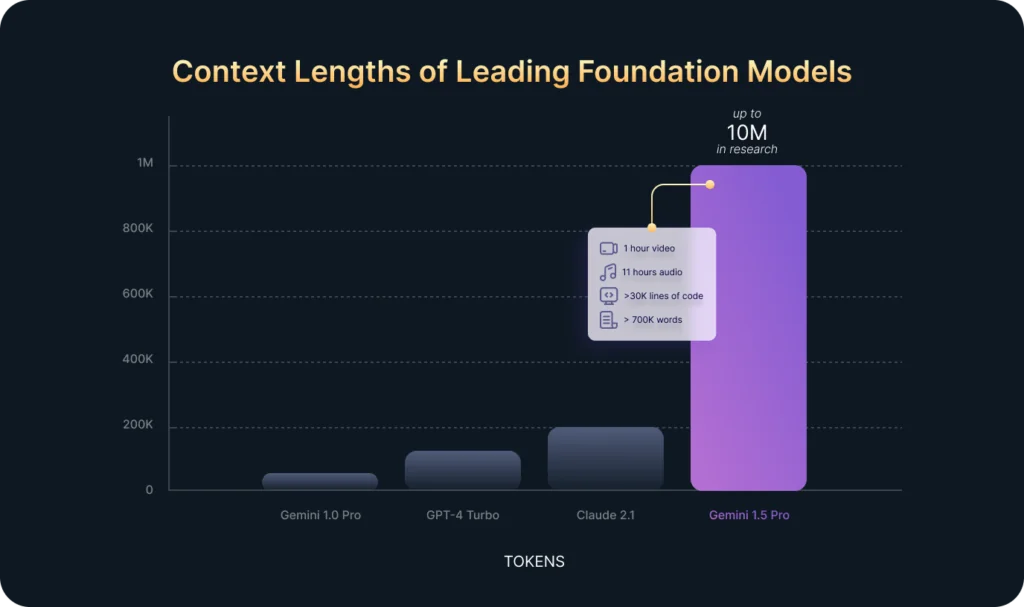
Gemini 2.0 Flash is Google’s workhorse model, designed for high-volume, low-latency tasks at scale. It offers native tool use capabilities and a 1-million-token context window with multimodal input. This AI model is suitable for general-purpose applications.
Gemini 2.0 Pro is an experimental model considered Google’s best for coding. It excels in general performance across a wide range of tasks. Gemini 2.0 Pro can process challenging prompts, making it suitable for professional-grade tools and large-scale applications.
Gemini 2.0 Flash-Lite is a lightweight variant designed for fast data analysis. It is Google’s most cost-efficient model yet, ideal for applications requiring high concurrency and lower costs.Gemini 2.5 Pro is Google’s most advanced model for complex tasks. It features native multimodality and a 1-million-token context window, with plans to expand to 2-million-tokens. The model can comprehend vast datasets from different information sources. Gemini 2.5 Pro is a thinking model that reasons before responding, which takes some time, but results in improved accuracy. It tops the LM Arena Leaderboard by a significant margin.
Gemini’s Use Cases:
- Overall Best Performance. According to LM Arena Leaderboard, Gemini 2.5 Pro is now at the top with the largest score jump ever, having a nearly 40 Elo points difference with competitors. Gemini 2.5 Pro ranked #1 across ALL categories and uniquely #1 in Math, Creative Writing, Instruction Following, Longer Query, and Multi-Turn interactions.
- Factual Accuracy. Google’s AI relies on vast databases and search results, ensuring its output is trustworthy. Gemini 2.5 Pro achieved a score of 18.8% on Humanity’s Last Exam, a challenging dataset designed to capture the human frontier of knowledge.
- Gmail integration. Using Gemini, you can enhance email management by providing personalized reply suggestions that incorporate your context directly within the platform. Gemini can also search your inbox for specific information using natural language queries.
Perplexity AI
Perplexity AI is a real-time, citation-based search assistant that integrates multiple advanced LLMs, including OpenAI’s GPT-4.1, Anthropic’s Claude 3.7 Sonnet, Google’s Gemini 2.5 Pro, and xAI’s Grok-2. While it doesn’t have its own proprietary model, Perplexity offers a unified interface for accessing these models.
Perplexity’s use cases:
- Search with real-time facts
Perplexity LLM delivers up-to-date, accurate answers by drawing from live web sources. Every response includes citations, ensuring transparency and credibility across all queries. It outperforms traditional search engines in speed and trustworthiness. - Education and learning support
Whether you’re a student, researcher, or lifelong learner, Perplexity provides instant explanations, source-backed answers, and the ability to explore topics in depth. Its thread follow-up and discovery library features make continuous learning seamless. - Research and citation-based Q&A
Ideal for academic or professional research, Perplexity LLM allows users to dig deeper into complex topics while maintaining source traceability. It excels at retrieving relevant information across multiple domains with clarity and precision.
Grok
Grok is developed by Elon Musk’s xAI and integrated into X (formerly Twitter). This LLM is trained on real-time data and designed for expressive, sometimes sarcastic interaction. xAI’s Grok series comprises several iterations, each enhancing capabilities in reasoning, multimodal processing, and real-time interaction.
Grok-1 was released in November 2023. This model marked xAI’s entry into AI development. This model featured a 314 billion parameter Mixture-of-Experts architecture and was open-sourced under the Apache 2.0 license. Grok-1 introduced real-time data integration from X (formerly Twitter) and emphasized humor and sarcasm in its responses.
Grok-2 was launched in August 2024. It expanded upon its predecessor by incorporating vision capabilities and image generation through the FLUX.1 model. It offered improved reasoning, multilingual support, and a more intuitive user experience. Grok-2 was available to Premium and Premium+ users on the X platform.
Grok-3 was introduced in February 2025. The LLM was trained with ten times the computational resources of Grok-2, utilizing xAI’s Colossus supercomputer. This model featured enhanced reasoning abilities, outperforming competitors like OpenAI’s GPT-4o and DeepSeek’s V3 on benchmarks such as AIME and GPQA. Grok-3 introduced “Think” and “Big Brain” modes for complex problem-solving and was integrated into Microsoft’s Azure AI Foundry platform.
Grok’s use cases:
- Pop culture and meme intelligence
Grok-2 is tuned for internet culture. It understands trending memes, viral moments, and cultural shifts as they happen, making it perfect for users who want commentary that’s both smart and in sync with the zeitgeist. - X-native engagement
Built directly into the X platform, Grok-2 enhances the user experience with conversational replies that blend with posts, threads, and trending topics. It offers a uniquely contextual assistant tailored for social interaction. - Entertainment with attitude
Unlike most polished assistants, Grok-2 thrives on being bold, opinionated, and kinda rebellious. It’s designed for users who prefer personality-rich answers, making it ideal for entertainment, debates, or fun late-night questions.
Microsoft Copilot
Microsoft Copilot is not a standalone language model, but a powerful AI layer built on OpenAI’s GPT-4o. Seamlessly embedded across the Microsoft ecosystem—including Word, Excel, Outlook, and Azure—Copilot transforms traditional Office tools into intelligent assistants. It adapts to different tiers:
Microsoft 365 Copilot integrates AI capabilities directly into Microsoft 365 applications like Word, Excel, Outlook, and Teams. It leverages large language models to assist with drafting content, analyzing data, and summarizing information. This tool is ideal for enterprise users seeking to augment their daily workflows with AI-driven insights.
Copilot Studio is a platform that allows users to build and customize their own AI-powered agents without extensive coding knowledge. These agents can be integrated into Microsoft 365 applications to automate tasks and provide specialized assistance. Copilot Studio is suited for organizations aiming to tailor AI solutions to their specific business needs.
Copilot for Azure assists IT professionals in managing cloud infrastructure by providing AI-driven recommendations and automating routine tasks. It helps in designing, operating, and optimizing applications and infrastructure within the Azure ecosystem. This tool is best for developers and IT administrators looking to streamline cloud operations.
Copilot Chat offers a conversational AI experience within Microsoft 365, enabling users to interact with AI to retrieve information, summarize content, and perform tasks through natural language queries. It’s particularly useful for users who prefer a chat-based interface to engage with AI functionalities across Microsoft applications.
Microsoft Copilot’s use cases:
- Workflow automation
Copilot streamlines repetitive tasks across Microsoft Office apps. From writing emails to designing presentations and drafting documents, it eliminates manual work and boosts productivity inside the tools professionals use daily. - Data analysis and reporting
Integrated deeply into Excel and Power BI, Copilot helps users clean data, generate insights, and even create formulas automatically. It’s ideal for business users who want fast, AI-powered support without needing advanced analytics expertise. - Enterprise-ready compliance
Designed for secure environments, Microsoft Copilot adheres to Microsoft’s enterprise compliance and privacy standards. It’s well-suited for industries with strict regulations, offering safe AI integration without compromising data governance.
DeepSeek
DeepSeek is an AI research group based in China. DeepSeek is a bilingual large language model released by a China-based research group. Positioned as a GPT-4-class model, it supports a 32K token context window and performs strongly in both English and Chinese. DeepSeek is fully open-sourced, making it accessible for fine-tuning and custom AI development. Available:
DeepSeek-V2 was released in May 2024. It is a Mixture-of-Experts (MoE) model with 236 billion total parameters, activating 21 billion per token. It offers efficient training and inference, with a 128K token context window, and supports both English and Chinese languages. This model laid the foundation for subsequent versions by introducing cost-effective training and firm performance.
DeepSeek-V2.5 Launched in September 2024. It combines the general language understanding of DeepSeek-V2-Chat and the coding capabilities of DeepSeek-Coder-V2-Instruct. With 238 billion parameters and 16 billion activated per token, it excels in both natural language processing and code generation tasks. Features include function calling, JSON output, and Fill-in-the-Middle (FIM) completion.
DeepSeek-V3 was introduced in December 2024. This LLM is a significant advancement with 671 billion total parameters and 37 billion activated per token. It utilizes a Mixture-of-Experts architecture and introduces Multi-head Latent Attention (MLA) for improved performance. The model supports a 128K token context window and demonstrates strong capabilities in reasoning, coding, and multilingual tasks.
DeepSeek-V3-0324 was released in March 2025. DeepSeek-V3-0324 is an updated checkpoint of DeepSeek-V3, featuring enhanced reasoning performance, improved front-end development skills, and smarter tool-use capabilities. It maintains the same architecture as its predecessor while offering refined functionalities.
DeepSeek’s use cases:
- Multilingual chatbot development
With native fluency in both English and Chinese, DeepSeek-V2 is ideal for building conversational agents that operate seamlessly across linguistic and cultural contexts. It performs especially well in bilingual environments and customer-facing applications. - Academic and commercial NLP
The model excels at tasks such as translation, summarization, and question-answering in Chinese-English scenarios. Its accuracy and high context window make it a strong tool for researchers, educators, and businesses working across global markets. - Open-source deployment
Because DeepSeek-V2 is openly available, developers can fine-tune and self-host the model to meet specific business or regulatory needs. It’s a popular choice for privacy-conscious organizations and those seeking full control over their AI systems.
Qwen
Qwen is a family of AI language models developed by Alibaba Cloud. These LLMs focus on providing open-source AI solutions under the Apache 2.0 license. Among its models available at the moment, there are Qwen3-235B-A22B, Qwen3-30B-A3B, and six dense models ranging from 0.6B to 32B parameters.
Qwen3-30B-A3B is a smaller model with 30B total parameters and 3B active at any time. It offers a balance of speed and capability with a 128K token context window. This model is suitable for applications where inference budget is a factor while still handling advanced problems.
Qwen3-235B-A22B is the flagship model in the Qwen family, featuring an architecture with 235B total parameters and 22B activated parameters. This model demonstrates superior reasoning capabilities, excellent alignment with human preferences in creative writing, and supports over 100 languages.
Qwen’s Use Cases:
- Code generation. Qwen3-235B-A22B achieves outstanding performance on coding benchmarks, including 70.7 on LiveCodeBench v5 and a CodeForces rating of 2,056. It demonstrates the capability to generate optimal code across multiple programming languages with strong agent-related task performance.
- Multilingual Applications. Qwen3 models support 119 languages and dialects, enabling extensive multilingual capabilities for international applications and use cases.
- Complex Reasoning Tasks. Qwen3 models excel in mathematics and reasoning, with the flagship model achieving 85.7 on AIME’24 and 81.5 on AIME’25. The models demonstrate scalable performance improvements directly correlated with the computational reasoning budget.
Mistral AI
Mistral AI is a European AI company based in France that develops high-performance LLMs. Their focus is on reasoning performance and full developer flexibility. Mistral models can be deployed both in the cloud and locally, giving companies full control over data. Currently, the main available models are: Mistral 7B, Mistral Large, and Mistral Codestral.
Mistral 7B is a free-to-use open-source model optimized for speed and low compute requirements. It is suitable for embedded applications and projects with limited infrastructure budgets. While it is efficient, its reasoning and accuracy are weaker than larger models, especially on complex analysis tasks.
Mistral Large is Mistral’s flagship model available via API and commercial licensing. It performs close to GPT-4o and Claude on reasoning and multilingual tasks. The model is designed for enterprise applications that require strong performance, privacy, and on-premises deployment. One drawback is that Mistral Large requires paid API usage and is not open-source like the smaller models.
Mistral Codestral is the newest model specializing in software development workflows. It supports multiple programming languages, handles large repositories, and offers advanced code reasoning.
Mistral AI Use Cases:
- Cost-Effective Solutions. For projects requiring budget efficiency, models like Mistral 7B offer strong performance while remaining free and lightweight.
- Longer Queries. Mistral Large supports extended context and maintains coherence across lengthy inputs, making it suitable for research reports, document processing, and technical planning.
- Versatile Applications. From natural language processing to enterprise automation, coding, data extraction, and multilingual tasks, Mistral’s ecosystem covers a broad range of use cases while allowing both cloud and on-prem deployment.
Conclusion
In conclusion, the current AI landscape offers a diverse range of solutions tailored to various business needs, from the advanced capabilities of ChatGPT and Gemini to the specialized performance of Claude and LLaMA models. By choosing the right AI model, businesses can enhance productivity, foster innovation, and maintain a competitive edge in a rapidly evolving market. Contact us to learn more about how our AI software development services can help your business thrive.


